Electricity : Magnetic and Heating effects class 8 Notes
ELECTRIC CURRENT AND ITS EFFECTS
Electrical energy is the most useful form of energy as it can easily be converted into various other forms of energy such as heat energy, light energy, mechanical energy and chemical energy.
Magnetic effect of electric current:
A current carrying conductor produces the same effect as produced by the magnetic field of a magnet. This effect of current is called the magnetic effect of electric current.
Solenoid:
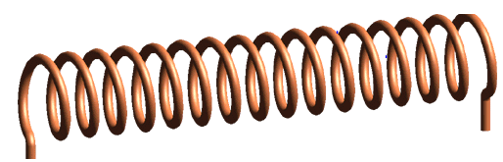
A cylindrical- shaped coil that exhibits magnetic properties similar to that of a bar magnet when current is passed through it is called a solenoid.
The strength of the magnetic field shown by a solenoid depends on the amount of current flowing through it and the number of turns of the coil.
Electromagnet:
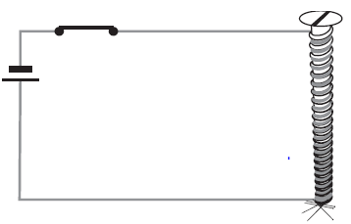
An Electromagnet is a device that act as a magnet when a current flows through its coil.
It consists of a magnetic material such a soft iron piece and the coil of insulated copper wire tightly wound around it.
The material on which the insulated wire is wound is called its core.
It is a temporary magnet that loses its magnetic property when the current through the circuit is withdrawn.
Applications of electromagnet:
Electromagnets have a variety of applications in industries and in our daily life. Some of the these are listed below:
In electric cranes to lift scrap iron
As armature of electric motors
In electronic devices such a television, radio and tape recorder
In magnetic levitation trains, mechanical relay circuits and electric bells
In CT/ MRI scanning for medical diagnosis.
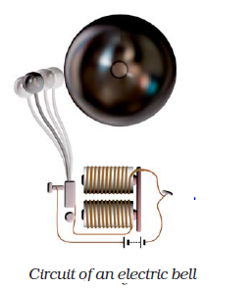
Electric bell:
It consists of an electromagnet and armature made of thick iron bar fixed on a spring, a make-and-break arrangement with the screw S and an iron strip P.
Heating effect of electric current:
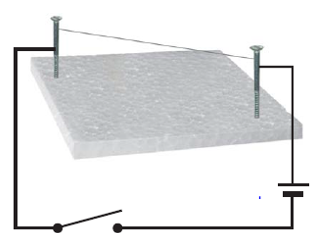
When electric current is passed through a conductor, it produces heat in the conductor and this effect is called the heating effect of electric current.
Electric iron, immersion heaters, hot plates, geysers, electric kettles are some of the electric appliances used, which work on the heating effect of the electric current.
All the devices have a coil of wire called an element. The heating element is made up of metal alloy called nichrome (alloy of 80% nickel and 20% chromium). Nichrome wire have high resistance to electric current and can withstand high temperatures. Due to this property, it is a good material for making heating elements.
When the appliance is switched on, the element becomes red hot and give out heat.
The amount of heat generated by a metal conductor (wire) depends on the strength of electricity flowing through it, the type of metal and on the length and thickness of the conductor.
What makes a bulb glow:
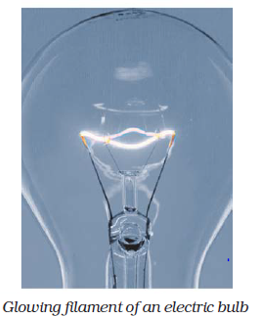
A bulb glows due to the heating effect of electric current.
A bulb has a partial vacuum, argon gas and a thin filament of tungsten.
Tungsten metal has a very high resistance and very high melting point.
When an electric current pass through the filament, due to its high resistance, its heat up quickly to about 2500 degree Celsius.
At this temperature, the tungsten filament begins to glow and emits light.
Electric fuse:
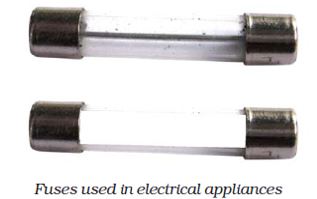
A fuse or an electric fuse is a safety device made of a material with low melting point. it is used to protect the electric circuit and devices in the circuit from the excess current passing through them.
How does a fuse work:
Electric fuse works on the principle of the heating effect of electric current.
The quantity of heat produced in a conductor by a current depends on the amount of current flowing through the conductor.
A fuse is a thin wire of short length that melts easily when heated.
When the fuse wire breaks due to heating by excess amount of current, the circuit breaks and becomes an open circuit; no current can flow through it and the devices in the circuit are safe.
The fuse wire is made from an alloy of tin and lead and has a low melting point. Hence, it melts easily when more than the designated amount of current flows through the circuit.
The main characteristic of a fuse wire are that it must have low melting point and relatively high resistance.