Exploring Forces Class 8 Notes - Science Chapter 5
On this page, you will find notes, questions, and answers to class 8 science chapter 8. These exploring Forces Class 8 Notes ,explanations, examples, and questions and answers are according to CBSE and the NCERT textbook. If you like the study material, feel free to share the link as much as possible.
Meaning of force
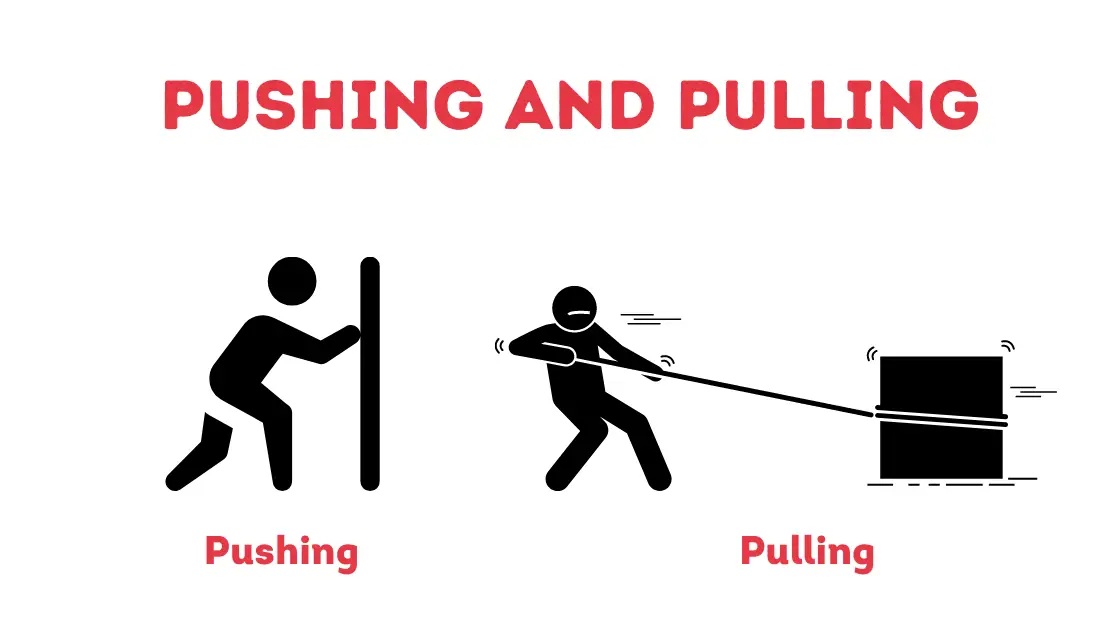
Force can be defined as a push or pull on an object. Both non-loving and living things can exert a force.
A force can be defined as a push or pull upon an object resulting from the object interaction with another object.
For example-Picking, Kicking, Shutting, Squeezing, Pushing, Lifting etc.
Force can also be defined as an influence that brings about a change in the speed, direction of motion, or shape of the object.
In order to move an object from one location to another, there must be a net force exerted on the object to trigger the object in motion.
More push is required to move a heavy object in comparison to a lighter object.
Question Can you lift a bucket of water without holding it?
Answer A pull action is required to lift a bucket. This is provided by the force exerted by the body holding the bucket. As a result, we need a holding to lift a bucket. This force is produced by the action of our body's muscles.
Question: Give two examples of each of the situations in which you push or pull to change the state of motion of objects?
Answer
Examples of pushing: (i) Player pushing a football using his foot. (ii) Pushing an open drawer to close it.
Examples of pulling: (i) pulling a toy car with thread to move (ii) Opening a drawer of a table.
What causes the force to arise?
The interaction between two objects arises from the force.
Force includes gravity, friction and force applied on an object in order to move it. The force causes a change in the speed or direction of motion.
An object will either be in motion or at rest as a result of forces. If an object is at rest and remains at rest, the forces acting on it are said to be balanced. For it to begin moving, we must apply additional force.
When force is applied, two objects are involved: one that applies the force and one that receives it.
For example- A football placed on the ground is at rest position. For it to move in any direction, some force should be applied to the ball. In order to move the ball player can hit the ball.
Force arises due to interaction
A force arises due to interaction between objects. When applying a force to an object, the interaction between object and the source of force is required.
For example- We can exert a force on a ball to move in any directions. It happens when we kick the ball, so the force that arises is due to the interaction between feet of the player and the ball.
Effects of force
Let us now look at some of the characteristics of force
A force can change the size and shape of an object. For example – While playing with clay we can change the shape of clay by applying force with our hands. The shape of rubber band changes when it is stretched.
A force can change the speed of a moving object. Force can slow down or completely stop a moving object. To do this we need to apply a force in a direction opposite to the direction of motion of the moving body.
A force can move an object which is at rest. For example – A stationary trolley or trolley which is at rest can be made to move by applying some force. So the motion of object can be halted by suitable application of force.
A force can change the direction of motion of a moving object. For example – A football can changes its direction by kicking it in a different direction.
Note – Change in the mass of an object is not an effect of force.
Question: A blacksmith hammers a hot piece of iron while making a tool, How does the force due to hammering affect the piece of iron?
Answer A blacksmith exerts muscular force when hammering a hot piece of iron. This muscular force modifies the shape of the iron, enabling it to be shaped as needed.
Types Of Forces
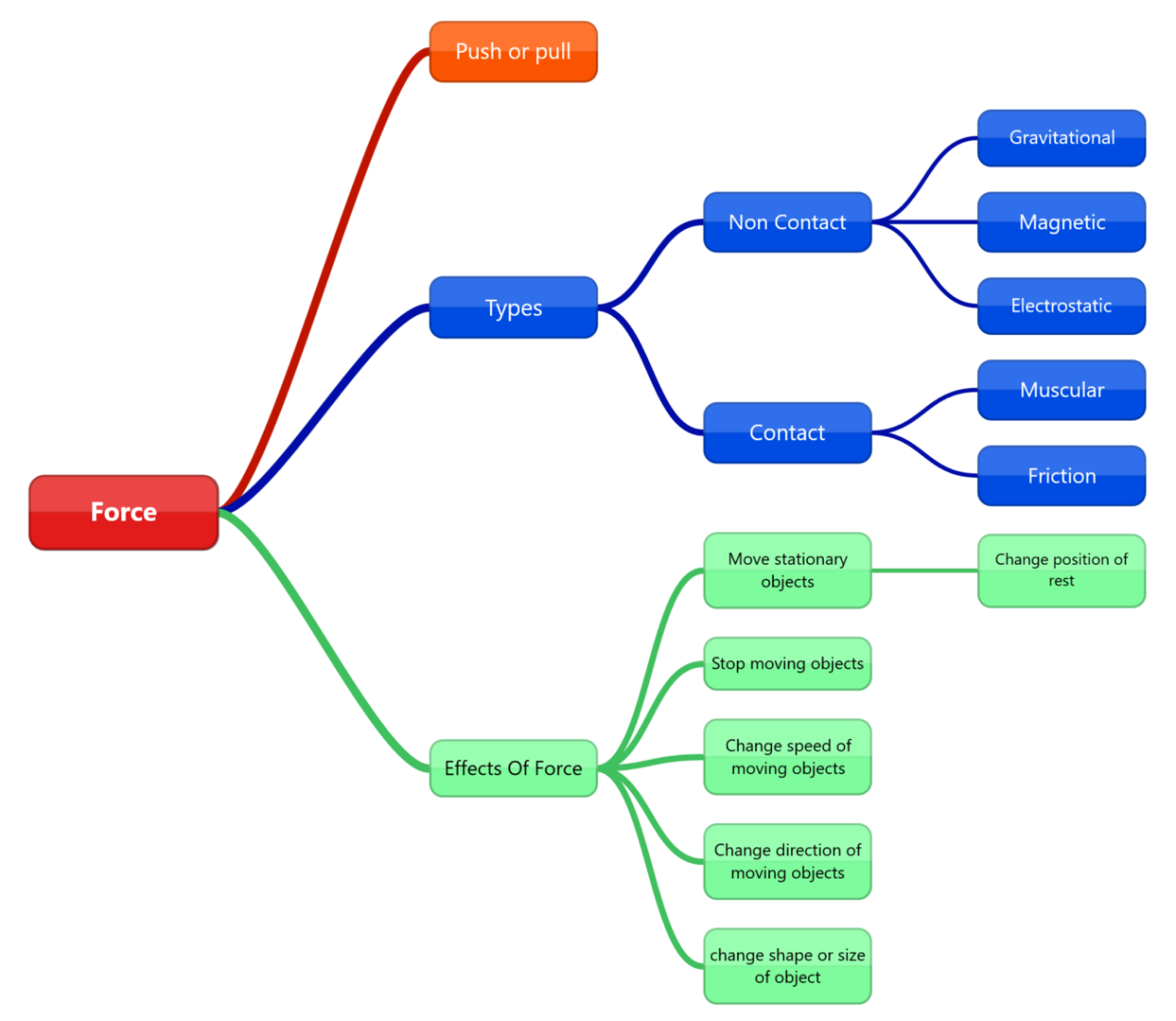
There are two types of forces namely contact force and non-contact force
1. Contact forces
These are the kinds of force that came into action when two interacting bodies are in physical contact with each other. Muscular force and frictional force is an example of contact force.
Types of Contact Force
a. Muscular force
It is a type of contact force. It is the force that is exerted by the muscles of the body.
For example- To lift an object we use a hand. If we want to pull a bucket of water or lift a heavy box it requires muscular force.
Like humans, animals also use muscular force.
b. Frictional force -
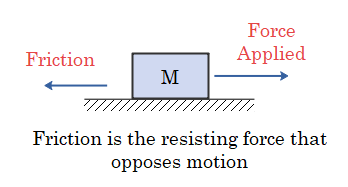
The force that causes objects to slow down and stop moving is called frictional force. Friction always acts in the direction opposite to the direction of motion of the object.
For example-This is due to the force of friction when a ball comes to rest after some time.
This happens due to friction between the ground and the ball.
2. Non-contact forces
These are the kinds of force that is came into action when two interacting bodies are not in physical contact with each other.
Types of Non-Contact Force
a. Magnetic force -
Magnetic force is the force exerted by a magnet on another magnet or on a piece of iron.
Because a magnet is surrounded by an unseen magnetic force field, it can act from a distance.
For example- To separate the iron objects from the garbage since a magnet can attract a piece of iron as the force between them is an attractive type of force.
b. Electrostatic force –
The force exerted by a charged body on another charged or uncharged body.
So, the force exerted by an electrostatic charge is referred to as an Electrostatic Force.
For example-Lightning. This force occurs due to electric charges. It can be both attractive and repulsive in nature.
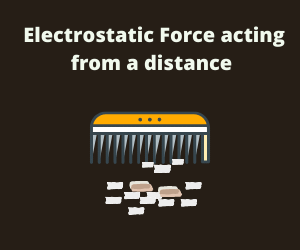
It is because of electrostatic force that bits of paper move towards the comb which was rubbed through dry hairs. This happens because when comb is rubbed through your dry hairs it acquires a property called electric charge.
Figure below shows Electrostatic force acting on bits of paper from a distance
c. Gravitational force –
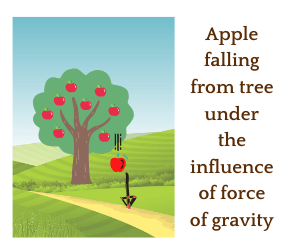
The force that pulls the objects towards the earth.
It is the force of attraction between the particles of matter.
For example – The falling of an apple from a tree.
Question: Name the forces acting on a plastic bucket containing water held above ground level in our hand.
Answer: Muscular force and gravitational force are the forces acting on the plastic bucket.
Magnitude Of Forces
By term magnitude of forces, we mean the net amount of all the forces being applied to the object. It is the sum of all forces operating on a body.
When two forces act in the same direction, the magnitude of the force increases. It is equal to the sum of both forces.
When two forces act in opposite directions, the magnitude of the force becomes less or decreases. It is the difference between the two forces.
How can we express the force?
A force is expressed by its magnitude and direction. The magnitude of the force is a numerical value. The direction of force is away from us when we push something and towards us when we pull something.
Units of force
The (Standard international system of the unit ) SI unit of force is called Newton.
The unit of force is named after the renowned scientist Sir Issac Newton.
The unit of force can be defined as the force needed to accelerate a body weighing 1kg by 1 meter per second.
F = m × a
Force Concept Map
Meaning of friction
When two objects with their surfaces in contact rub against each other, they cause friction.
Friction is the force opposite to the direction of motion.
Friction is the force that acts when one object tries to move or slide over the surface of another object.
It can be defined as the resistance of motion when one objects rub against other.
Friction works against the motion and acts in the opposite direction. However, friction does not always oppose the motion, it also helps in motion.
The S.I unit in which frictional force is measured is, Newton.
Examples of friction
Friction between the tyres of vehicles and the road.
To make the box move, we have to apply a force to overcome the force of friction.
Friction between pen and book.
What is Friction?
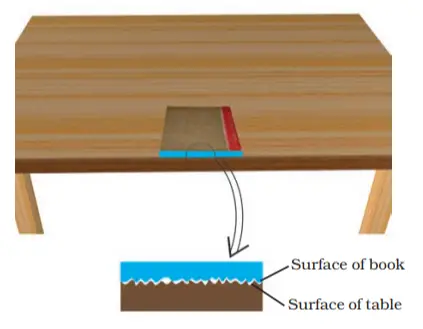
The force, which opposes the relative motion between two surfaces in contact is known as friction. It occurs due to surface irregularities of the two objects in contact. What is Surface Irregularities?
This unevenness of the surface is called surface irregularities or roughness. What are the examples of friction?
1. Writing on paper using a pencil: Friction between the graphite in a pencil and a sheet of paper leaves a mark on the paper. 2. Warming hands in winter: As friction produces heat you can warm your hands in winter by rubbing them against each other. So heat from friction can be useful.
3. Gymnasts apply some coarse substances on their hands to increase friction for better grip.
Cause of friction
The root cause of friction is the irregularities or rough edges that is ridges and grooves present on the two surfaces which are in contact. Due to this they get interlocked with each other and cause friction.
Even smooth surfaces like tiles in houses, office, school have a large number of irregularities when seen under a microscope.
Why is it difficult to walk on a smooth or wet floor?
Due to less friction between our foot and floor. As the interlocked irregularities possess a layer of water which decreases friction. What Causes Friction?
Friction exists between two surfaces due to abnormalities on the surfaces of the objects in contact, as well as the interlocking of the two surfaces' micro-level imperfections. So, this force is caused by molecular adhesion, surface roughness, ploughing effect and deformations.
Factors affecting friction
The force of friction depends on the following factors
It acts in a direction opposite to the direction of motion.
It depends on the mass of the body
It depends on the surface's nature, as smooth surfaces have fewer irregularities and thus less friction. As a result, moving an object to a smooth surface is easier than moving an object to a rough surface.
Which one is easier to hold in hand: an earthen pot or a glass tumbler. Why?
Because of the smoother surface, the glass tumbler creates less friction and it is not easier to hold. On the other hand, an earthen pot has a rougher surface which creates more friction and thus makes it easier to grip.
Spring Balance
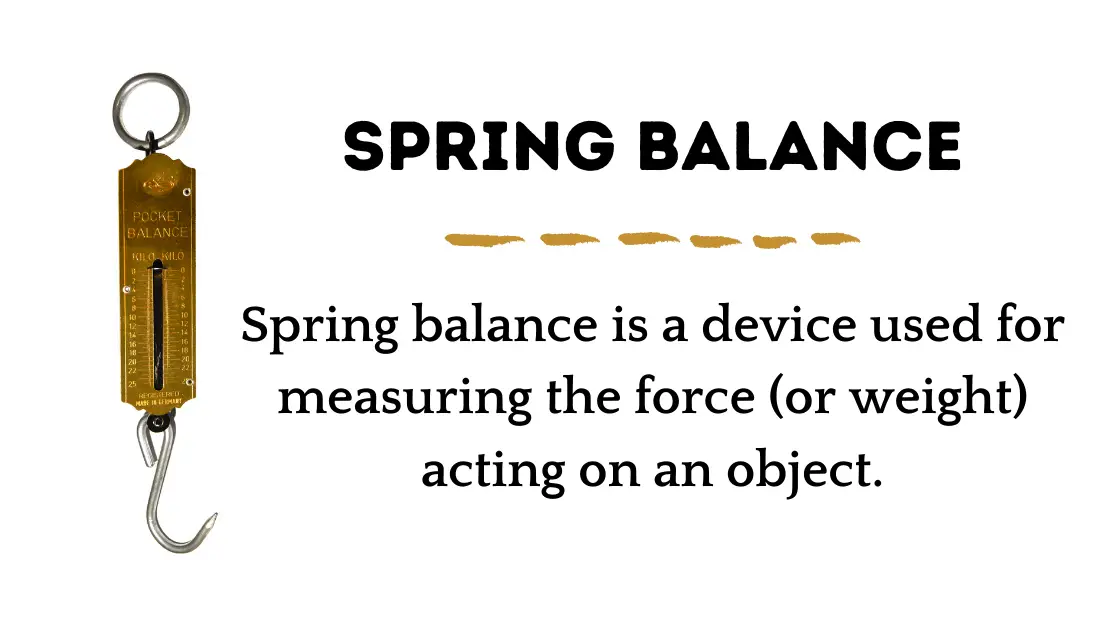
Spring balance is a device used for measuring the force (or weight) acting on an object.
Christian Huygens, invented the first balance springs. Spring balance measures the weight. Spring balances are used commercially.
Working of spring balance
Spring balance consists of a coiled spring that gets stretched when a force is applied to it. Stretching of the spring is measured by a pointer moving on a graduated scale. The reading on the scale gives the magnitude of force or weight of the object.
Types of friction
There are four types of friction namely
1.Static friction
2.Rolling friction
3.Sliding friction
4.Fluid friction
1. Static friction
The word static means at rest.
Static friction can be defined as the friction that acts when we try to move an object at rest or the object which is not moving. It is the strongest type of friction.
For example –
Cup placed on a table
Scenery hanging on a wall
A car parked on a hill.
Limiting friction is the friction acting on a body when it is about to start moving.
2. Sliding friction
Sliding friction is smaller than static friction as a smaller force is now required to keep the object moving.
Sliding friction can be defined as the friction that acts when two surfaces slide over each other. If the applied force exceeds the limiting friction the irregularities on it do not get interlocked on the surface on which it is moving.
3.Rolling friction
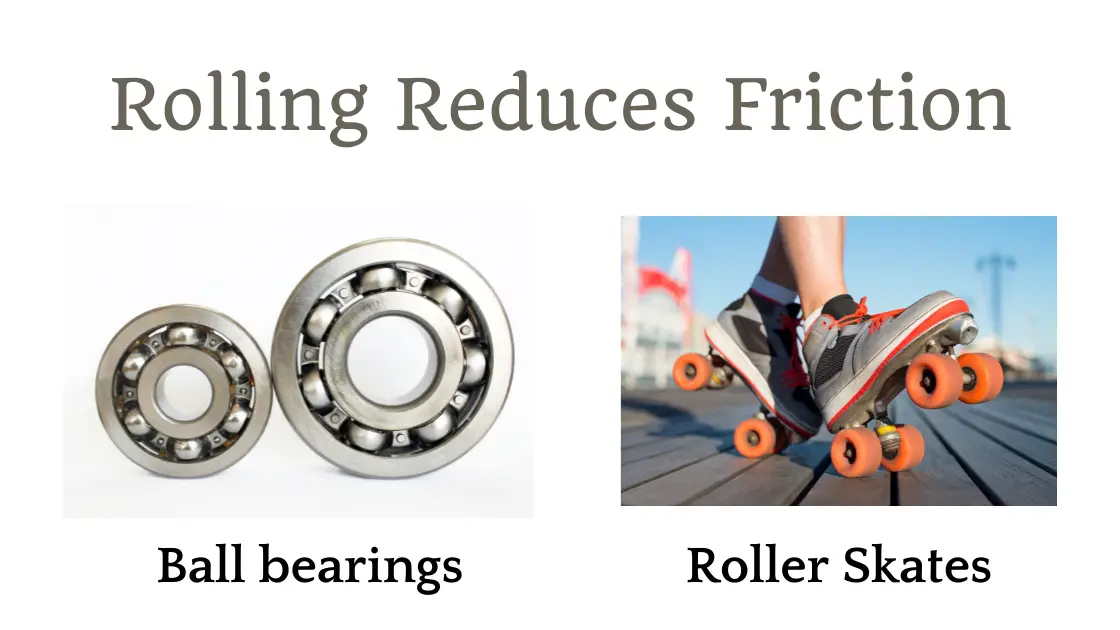
Rolling friction is always less than sliding friction as rolling reduces friction. Rolling friction is the weakest type of friction.
Rolling friction can be defined as the force that opposes the motion when an object rolls over another object.
For example –
Ball bearings
Skateboards.
What are the benefits of using ball bearings?
Due to the fact that rolling friction is less than sliding friction, ball bearings assist in maintaining the smallest possible surface of contact between two moving surfaces.
4. Fluid friction
The above three friction occur between solid surfaces whereas fluid friction occurs in fluids, that is in liquids or gases. A fluid is a substance that can flow and take the shape of a container.
Fluid friction can be defined as the friction that occurs when objects move across fluids. Another name for fluid friction is a drag. It resists the movement of viscous fluids relative to each other.
The force exerted by fluids is called drag. Drag force acts in a direction opposite to the direction of motion of the object. For example - When an aeroplane moves at a high speed it experienced air resistance.
Fluid friction depends on the following factors
speed of the object with respect to the fluid.
the shape of the object.
size of the object.
nature of the fluid.
Ways to reduce fluid friction
Firstly the question arises that why there is a need to reduce fluid friction.
As when objects move through fluids, they lose some of their energy in overcoming the fluid friction which decreases the efficiency of an object. To overcome this there is a need to reduce fluid friction.
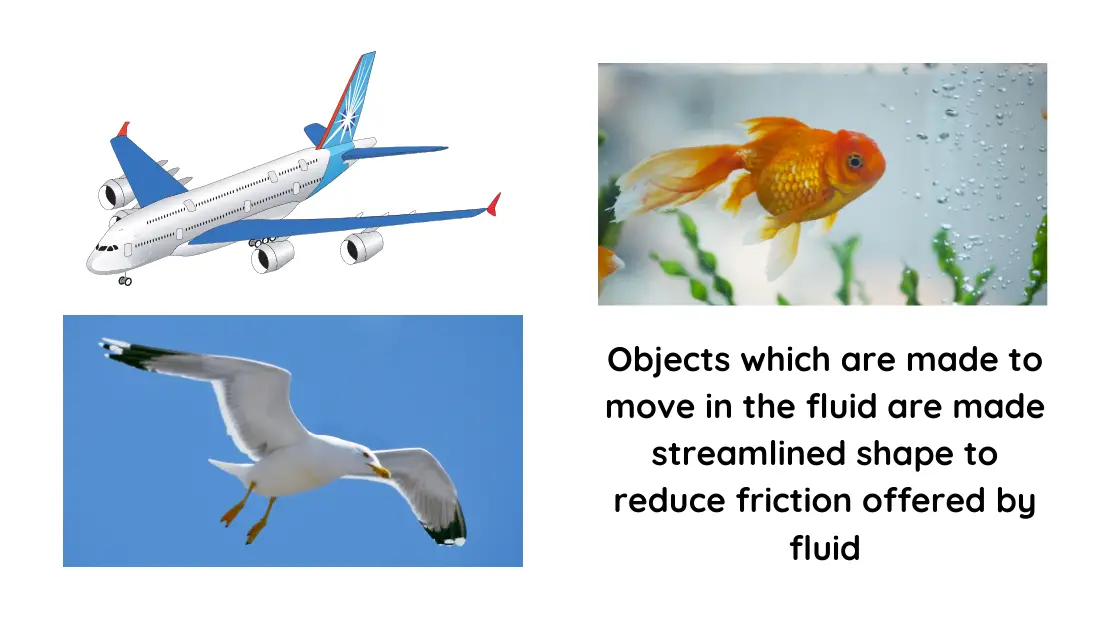
Fluid friction can be reduced by moulding the shape of an object which offers little resistance to fluids. The streamlined shape is best suited for objects that move in air or water. The streamlined shape is like a thin wedge that cut the air or water and moves forwards.
For example – An aeroplane has a special shape called streamlined shape to reduce friction offered by air. Similarly, boats, birds and fishes have this special and suitable shape to reduce fluid friction and avoid loss of energy.
What are the types of friction?
The four types of friction are static, sliding, rolling and fluid frictions. What is fluid friction?
Fluid friction is the frictional force exerted by fluids i.e., liquids and gases.
Friction - A necessary evil
Friction is called a necessary evil as friction has its advantages as well as disadvantages also.
On the soles of shoes, the grooves are present. Grooved soles provide increased friction to the ground, resulting in a greater grip when walking. Because the earth has friction, we can walk easily. As a result, friction is required even in simple tasks such as walking. Moving on a wet muddy route or a damp marble floor is a challenging chore. This is due to the fact that these surfaces provide relatively little friction to a person's feet.
Advantages of friction
Friction helps in the generation of heat.
Friction helps in stopping bicycle or any vehicle by applying brakes.
Nails can be fixed in a wall due to friction
Friction helps to write, walk.
Jumping out of an aeroplane with a parachute.
Ignition of matchsticks.
The motion of pistons.
Provide support to the ladder against the wall.
Disadvantages of friction
Friction produces heat which may damage machines and cause the wastage of energy.
Friction results in the wear and tear of objects, for example, the moving parts of a machine, the tyres of a car, the soles of shoes, and so on.
Friction resists motion
The cause of forest fires is the friction between tree branches.
Production of noise in machines due to friction.
Consumption of more fuel in vehicles.
Ways to reduce friction
Use of lubricants (Substances like oil or grease polish on the surface of machines to reduce friction and the process of applying lubricants to machines is known as lubrication)
The use of wheels also helps to reduce friction.
The streamlined body of an object can reduce friction.
The use of ball bearings between machine parts greatly helps to reduce friction as rolling friction is less than sliding friction.
Sprinkling powder on dholak can reduce friction.
Polishing surfaces that come into contact with one another to way to reduce friction. Polishing the surface eliminates imperfections and thereby smooths the surface.
What is lubrication?
Lubricants are substances like oil and grease etc. They help to reduce friction by forming a thin film between the different parts of a machine.
Ways to increase friction
Under some circumstances, there is a need to increase friction
Make surfaces rougher- The roughness of the surfaces in contact can be enhanced to increase friction.
By increasing the mass of the object that is moving.
The treads(A series of patterns )present on the tyres of car, buses and trucks help to increase friction
The grooves on the sole of shoes help to increase friction and provide better grip to the ground.
The brake shoes in automobiles are used to increase friction.
Why are brake pads used in the brake system of automobiles and cycles?
Brake pads are used to improve friction, allowing the brake to operate more effectively. When we drive the car, the pads do not make contact with the wheels, but when we press the brake lever, the pads interrupt the rim's motion due to friction, and the wheels come to a halt.