physicscatalyst.com logo


๐Ÿ“š Class 9 Science | Chapter 2 | NCERT

Cell: The Building Block of Life

Welcome to Class 9 Cell notes for Chapter 2. The topics in this page are Discovery of cell, Cell Theory, Shape, size and number of cells, Differences between Prokaryotic and Eukaryotic cells, Structure of cell, Cell Membrane, Cell Wall, Cell organelles and Nucleus. This is according to CBSE and the NCERT textbook.

๐Ÿ”ฌ Discovered by Robert Hooke, 1665
๐Ÿ“ Limit of resolution: 0.1 mm
๐Ÿงฌ Cell โ†’ Tissue โ†’ Organ โ†’ System
5
Hands-on Activities
10+
Cell Organelles
3.5B
Years of Cell Evolution
100%
Free Study Material

Jump to Any Topic


Introduction

  • The body of all organisms is made up of tiny microscopic units called cell.
  • The cell is a fundamental, structural and functional unit of living organisms and basic unit of life.
  • All living organisms are made up of cells. Cells make tissues, tissues together make organ, organs make organ system and organ systems make body of organisms. So cell is called structural unit of life.
  • All the basic functions of the body like respiration, excretion etc. are carried out by cell through its cell organelles, so cell is called functional unit of life.
  • Cell biology is the study of cells in all aspects of structure and functions.

๐Ÿ’ก Important Concept

Hierarchy of Organisation: Cell โ†’ Tissue โ†’ Organ โ†’ Organ System โ†’ Organism
Example: Nasal pores + Nasal cavity + Trachea + Lungs = Respiratory System

Discovery of cell

  • Cell was first discovered by Robert Hooke in 1665. He observed the cell in a cork slice with the help of a primitive microscope.
  • Anton Von Leeuwenhoek (1674) was the first to observe free cells, like bacteria, protozoa, red blood cells and sperms in his home made microscope.

๐Ÿ”ฌ Did You Know?

Robert Hooke's microscope could magnify objects only 200-300 times, but that was enough to see the box-like compartments in cork which he named "cells" (from Latin cella meaning small room).

Cell theory

  • The cell theory, that all the plants and animals are composed of cells and that the cell is basic unit of life, was presented by two biologists, M. Schleiden (1838) and T. Schwann (1839).
  • The cell theory was further expanded by a German physiologist, Rudolf Virchow (1855). He gave the phrase Omnis cellula-e-cellula, i.e., all cells arise from pre-existing cells.
  • Modified cell theory is termed as cell principle or modern cell theory which postulates that:
    • All living organisms are composed of cells or cell products.
    • All living cells arise from pre-existing cells.
    • All cells are basically alike in chemical composition and metabolic processes.

The functions of an organism as a whole is the result of the activities and interaction of the constituent cells.

โญ Three Postulates of Cell Theory

  1. All living organisms are made up of one or more cells
  2. The cell is the basic unit of structure and function
  3. All cells arise from pre-existing cells

โ†’ Learn more: Cell Theory โ€” Class 9 (Complete Guide)

Shape, size and number of cells

Cell shape:

  • The shape of cells is related to the specific function they perform.
  • Some cells like Amoeba and WBCs have changing shapes.
  • In some cases the cell shape could be more or less fixed and peculiar for a particular type of cell; for example, nerve cells have a typical shape.

Cell size:

  • The size of the cell also varies considerably in different animals and plants.
  • The average cell size varies from 0.5 to 20ยต (ยต = micrometre).
  • In human body, the smallest cell is RBC and the longest one is the nerve cells.

Cell number:

  • The number of cells in living beings differs from the one in unicellular organisms to many in multicellular forms.
  • The number of cells is not definite in multicellular organisms, and may increase along with the growth and volume of organism.

Join PhysicsCatalyst WhatsApp Channel


Types of Cells

Chapter 5 Fundamental unit of life class 9 notes

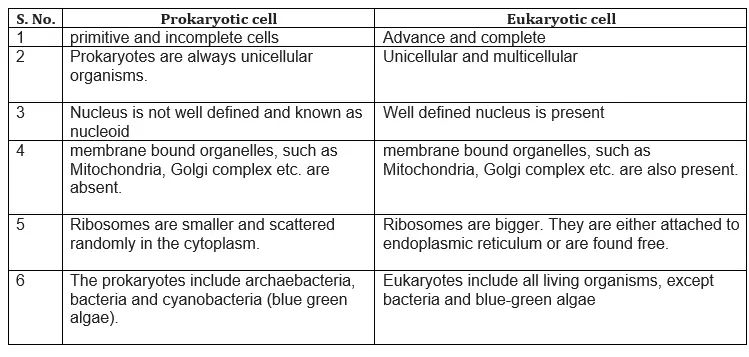
Differences between Prokaryotic and Eukaryotic cells

Differences between Prokaryotic and Eukaryotic cells

๐Ÿ”‘ Key Difference

Prokaryotic cells (bacteria) do not have a membrane-bound nucleus. Eukaryotic cells (plants, animals) have a true nucleus with a nuclear membrane.

โ†’ Compare in detail: Prokaryotic vs Eukaryotic Cells

Structure of cell

Structurally the cell is formed of three major parts:

  1. Plasma membrane or cell membrane
  2. Cytoplasm and its contents
  3. Nucleus

Plasma membrane (cell membrane)

  • Plasma membrane is the outermost covering of the cell that separates the contents of the cell from its external environment.
  • Plasma membrane is living, thin, delicate, elastic, selectively permeable membrane.
  • The plasma membrane is flexible and made up of organic molecules called lipids and proteins.

Want to learn more? Explore the Fluid Mosaic Model and understand selective permeability in detail. Also see: Cell Membrane vs Cell Wall

Functions:

  • Plasma membrane permits the entry and exit of some materials in the cells. It also prevents movement of some other material. Therefore, the plasma membrane is called a selectively permeable membrane.
  • Substances can pass across a membrane by two processes โ€” diffusion and osmosis.
    Diffusion

    "Diffusion is the spontaneous movement of molecules from a region of its higher concentration to a region of its lower concentration."

    Example: Movement of carbon dioxide and oxygen during respiration in organisms.

    Osmosis

    The movement of water molecules through a selectively permeable membrane from a region of higher water concentration to a region of lower water concentration is called osmosis.

    In plants, water from the soil enters root cells by this process.

What happens if you put a cell into solution of sugar or salt prepared in water?

Hypotonic Solution

External solute concentration < Internal
Result: Cell swells
Process: Endosmosis (water enters)

Isotonic Solution

External solute concentration = Internal
Result: No change
Process: Equal movement

Hypertonic Solution

External solute concentration > Internal
Result: Cell shrinks
Process: Exosmosis (water leaves)

Cell wall

  • In plant cells, there occurs a rigid cell wall which lies outside the plasma membrane.
  • Cell wall is thick, non-living and permeable covering made up of cellulose. Cellulose is a kind of carbohydrate (polysaccharide) and it provides structural strength to the plant.

Functions:

  1. Cell wall protects cell membrane and the internal structures of the cell.
  2. It provides rigidity and determines the shape of the plant cell.
  3. It prevents drying of the cell and helps it to bear unfavourable conditions.
  4. It provides mechanical strength to the plant cells.

๐ŸŒฟ Why do plants need cell walls?

Plants cannot move from place to place, so they need rigidity to withstand environmental stresses like wind and rain. The cell wall provides this support. Animal cells don't need cell walls because they can move and their flexible cells support tissue movement.

โ†’ Read more: Cell Wall โ€” Structure and Function

Protoplasm

  • All cells contain living substance called protoplasm. It is jelly-like, viscous, colourless semi-fluid substance in which various cell organelles and inclusion remains in colloidal form.
  • Protoplasm can be distinguished in two forms:
    1. Cytoplasm: it is that part of protoplasm which surrounds the nucleus.
    2. Nucleoplasm: it is that part of protoplasm which is located inside the nucleus.

Protoplasm = Cytoplasm + Nucleoplasm

Cytoplasm

The part of the cell which occurs between the plasma membrane and nucleus envelope is called the cytoplasm

  • Cytoplasm consists of an aqueous ground substance, the cytosol, containing a variety of cell organelles and other inclusions such as insoluble waste and storage product (starch, lipid, etc.).
  • Chemically cytoplasm contains about 90% water, 7% proteins, 2% carbohydrates and lipids and 1% inorganic minerals, vitamins, etc.

Cell organelles

  • A cell has to perform different functions with the help of its various membrane-bound cell organelles.
  • Cell organelles are "small organs" of the cell and are found embedded in the cytosol. They form living part of the cell and each of them has a definite shape, structure and function.
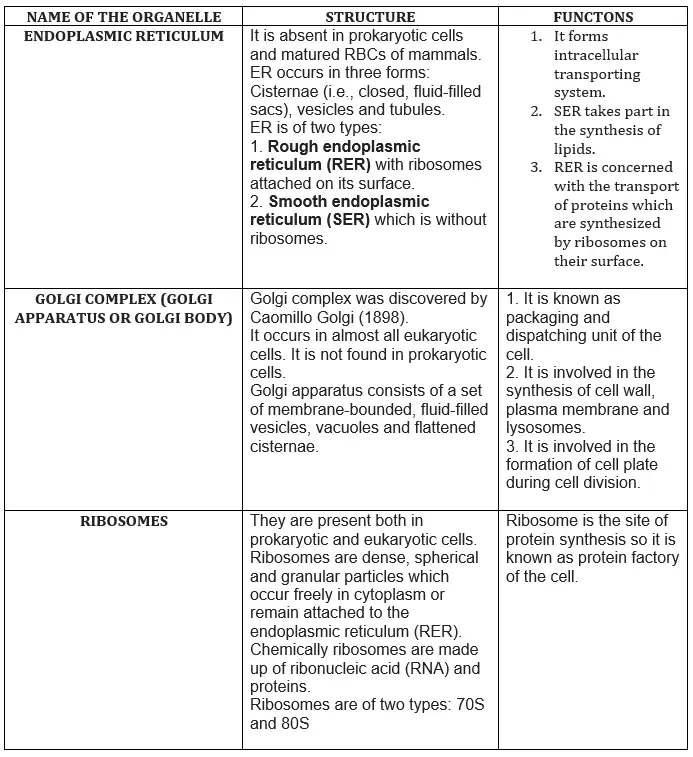
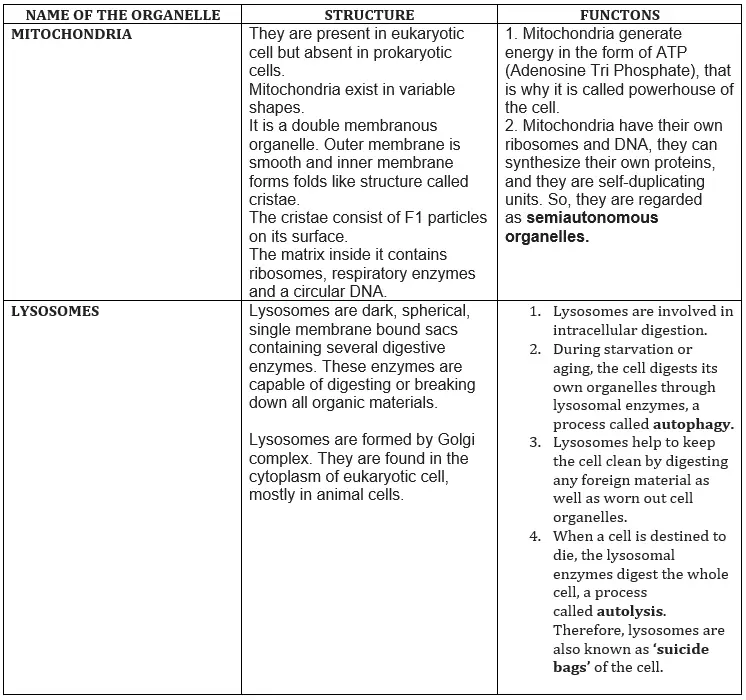
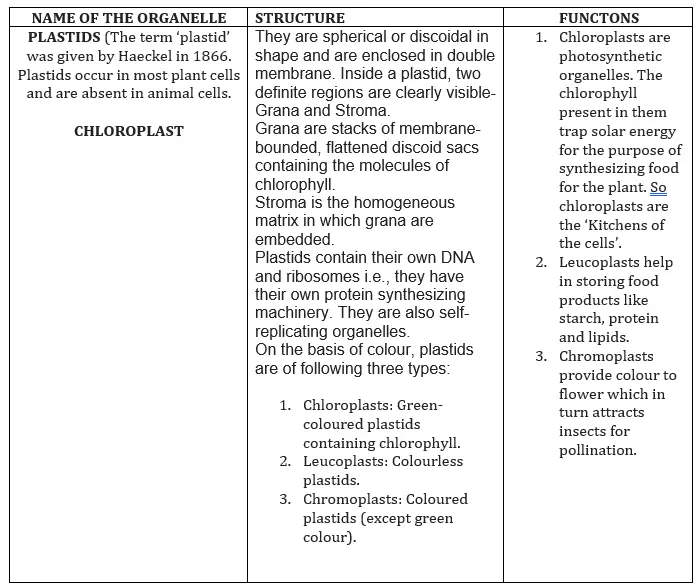
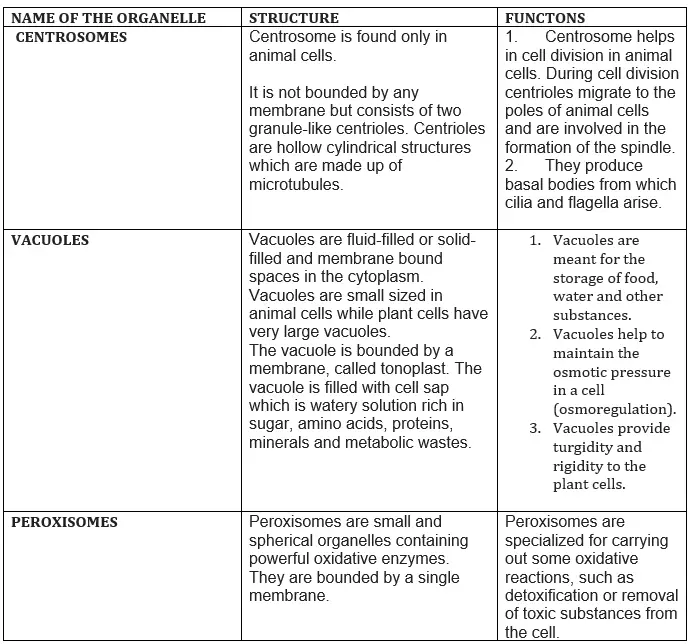
Cell organelles Chapter 5 Fundamental unit of life class 9 notes PLASTIDS CENTROSOMES,VACUOLES,PEROXISOMES

Cell Organelles โ€” Summary Table

Organelle Nickname Function
Nucleus Control centre Controls all cell activities; stores genetic information (DNA)
Ribosomes Protein factory Site of protein synthesis
Endoplasmic Reticulum (ER) Manufacturing factory Synthesis and transport of proteins (RER) and lipids (SER)
Golgi Apparatus Post office Modifies, sorts, and packages proteins for transport
Mitochondria Powerhouse Produces energy (ATP) through cellular respiration
Lysosomes Suicide bags / Cleaners Digest waste and damaged organelles
Chloroplasts Food factory Photosynthesis (convert sunlight to glucose)
Vacuoles Storage tanks Store water, minerals, waste; maintain turgor pressure

Nucleus

  • The nucleus is a major, centrally located spherical cellular component. It is the centre from where all cellular activities are controlled. It is the carrier of hereditary material in the cell.
  • It is bounded by two membranes, both forming a nuclear envelope. The nuclear envelope contains many pores known as nuclear pores and encloses the liquid ground substance, the nucleoplasm.
  • The nuclear pores allow transfer of materials between the nucleoplasm and the cytoplasm. Within nucleoplasm are embedded two types of nuclear structures โ€” nucleolus and chromatin material.

Nucleolus:

  • The nucleolus may be one or more in number and is not bounded by any membrane.
  • Nucleolus consists of DNA, RNA and protein.
  • It is the site of ribosome formation. Nucleolus is known as factory of ribosomes.

Chromatin material:

  • The chromatin is a thin, thread-like intermingled mass of chromosome material and composed of the genetic substance DNA (deoxyribonucleic acid) and proteins (i.e., histones).
  • DNA stores all the information necessary for the cell to function (metabolism), to grow and to reproduce further cells of the next generation.
  • The chromatin is condensed into two or more thick ribbon-like chromosomes during the division of cell.
  • Functional segments of DNA are called genes.
  • Genes carry information for protein synthesis, which in turn control the development of characters. Since genes are present on chromosomes and chromosomes pass from one generation to the next, genes are called hereditary units.

Join PhysicsCatalyst WhatsApp Channel


Functions of nucleus:

  1. The nucleus controls all metabolic activities of the cell. If the nucleus is removed from the cell, the protoplasm ultimately dries up and dies.
  2. It regulates the cell cycle.
  3. It is the storehouse of genes which are concerned with the development and manifestation of all the body characters.
  4. Nucleus helps in the formation of ribosomes and RNA.
  5. It helps in the transmission of characters from one generation to the next.

Test Your Knowledge

Test your Knowledge โ€” Part 1

Fill in the blanks

  1. ______________ are "small organs" of the cell and are found embedded in the cytosol.
  2. ______ discovered Golgi complex in _____
  3. ______________ apparatus consists of a set of membrane-bounded, fluid-filled vesicles, vacuoles and flattened cisternae.
  4. _____________ are present both in prokaryotic and eukaryotic cells.
  5. Chemically ribosomes consists of _______ and ________
  6. _______________ is the site of protein synthesis so it is known as protein factory of the cell.
  7. ____ is a double membranous organelle
  8. Mitochondria have their own ribosomes and __________________, they can synthesise their own proteins, and they are self-duplicating units.
  9. ______________ are dark, spherical, single membrane bound sacs containing several digestive enzymes.
  10. _____________ helps in the formation of ribosomes and RNA.
  11. When a cell is destined to die, the lysosomal enzymes digest the whole cell. This process is known as __________
  12. PLASTIDS term is given by __________________ in _____
  13. ____________ are spherical or discoidal in shape and are enclosed in double membrane.
  14. ______________ is the homogeneous matrix in which grana are embedded.
  15. Chloroplasts are green-coloured plastids containing __________________.
  16. The chlorophyll present in Chloroplasts trap solar energy for the purpose of synthesising food for the __________________.
  17. _____________ carry information for protein synthesis, which in turn control the development of characters.
  18. _________ are small and spherical organelles containing powerful oxidative enzymes and are specialised for carrying out some oxidative reactions, such as detoxification or removal of toxic substances from the cells
  19. The _______________ is a major, centrally located spherical cellular component.
  20. The nuclear envelope contains many pores known as nuclear pores and encloses the liquid ground substance, the __________________
  21. Nucleolus is made of __________________, RNA and protein.
  22. Nucleolus is called as __________________ of ribosomes.
  23. The __________________ is a thin, thread-like intermingled mass of chromosome material and composed of the genetic substance DNA (deoxyribonucleic acid) and proteins
  24. Functional segments of __________________ are called genes.
  25. ______________ are fluid-filled or solid-filled and membrane bound spaces in the cytoplasm.
  26. Lysosomes are formed by __________________ complex. They are found in the cytoplasm of eukaryotic cell, mostly in animal cells.
View Answers
  1. Cell organelles
  2. Camillo Golgi and 1898
  3. Golgi
  4. RIBOSOMES
  5. RNA and proteins
  6. Ribosome
  7. Mitochondria
  8. DNA
  9. Lysosomes
  10. Nucleus
  11. autolysis
  12. Haeckel and 1866
  13. CHLOROPLAST
  14. Stroma
  15. chlorophyll
  16. plant
  17. Genes
  18. peroxisomes
  19. nucleus
  20. nucleoplasm
  21. DNA
  22. factory
  23. Chromatin
  24. DNA
  25. VACUOLES
  26. Golgi

Test your Knowledge โ€” Part 2

Fill in the blanks

  1. The cell is a fundamental, structural and functional __________________ of living organisms and basic __________________ of life.
  2. All __________________ are made up of cells.
  3. Cells make tissues, tissues together make organ, organs make organ __________________ and organ __________________s make body of organisms.
  4. Cell is called structural unit of __________________.
  5. All the basic functions of the body like respiration, excretion are carried out by __________________ through its __________________ organelles, so __________________ is called functional unit of life.
  6. Cell was first discovered by _____ in _____.
  7. Two biologists ______ and _______ presented the cell theory which says that all the plants and animals are composed of cells and that the cell is basic unit of life
  8. All cells are basically alike in chemical __________________ and metabolic processes.
  9. Some cells like __________________ and WBCs have changing shapes.
  10. The smallest cell in human body is __________________ and the longest one is the ______
  11. The prokaryotes include archaebacteria, bacteria and cyanobacteria (blue green __________________).
  12. __________________ membrane is living, thin, delicate, elastic, selectively permeable membrane and is flexible and made up of organic molecules called lipids and proteins.
  13. Substances can pass across a membrane by two processes โ€” __________________ and _____
  14. __________________ is the spontaneous movement of molecules from a region of its higher concentration to a region of its lower concentration.
  15. The movement of water molecules through a selectively permeable membrane from a region of higher water concentration to a region of lower water concentration is called __________________.
  16. If the medium surrounding the cell has a higher water concentration than the cell, then the cell will gain water by osmosis. Such a dilute solution is called ____________
  17. The swelling up and increase of volume of cell as a result of water movement inside the cell is known as ____________
  18. If medium surrounding the cell is exactly the same water concentration as the cell, there will be no net movement of water across the plasma membrane resulting in no change in the size of the cell. Such a solution is called ______
  19. If the medium surrounding the cell has a lower concentration of water than the cell, then cell will lose water by osmosis. Such a concentrated solution is called _________________
  20. The shrinking and reduce in volume of cell as a result of water movement outside is known as__________
  21. __________________ is a kind of carbohydrate (polysaccharide) and provides structural strength to the plant.
  22. _____________ protects cell membrane and the internal structures of the cell
  23. All cells contain living substance called __________________ which is jelly-like, viscous, colourless semi-fluid substance in which various cell organelles and inclusion remains in colloidal form.
  24. ________ is part of protoplasm which surrounds the nucleus.
  25. ______ is part of protoplasm which is located inside the nucleus.
  26. Chemically cytoplasm contains about 90% _____, 7% _____, 2% _________ and lipids and 1% inorganic minerals, vitamins
View Answers
  1. unit, unit
  2. living organisms
  3. system, system
  4. life
  5. cell, cell, cell
  6. Robert Hooke and 1665
  7. M. Schleiden (1838) and T. Schwann (1839)
  8. composition
  9. Amoeba
  10. RBC, nerve cells
  11. algae
  12. Plasma
  13. diffusion and osmosis
  14. Diffusion
  15. Osmosis
  16. hypotonic solution
  17. endosmosis
  18. isotonic solution
  19. hypertonic solution
  20. exosmosis
  21. Cellulose
  22. Cell wall
  23. protoplasm
  24. Cytoplasm
  25. Nucleoplasm
  26. water, protein, carbohydrate

Scientists Timeline โ€” Who Discovered What

1665
Robert Hooke
First observed cells in a cork slice using a primitive microscope. Named them "cells" because they looked like small rooms (Latin: cella).
1674
Anton von Leeuwenhoek
First to observe free-living cells like bacteria, protozoa, red blood cells and sperms using his homemade microscope.
1838
Matthias Schleiden
German botanist who proposed that all plants are made of cells. Co-founder of Cell Theory.
1839
Theodor Schwann
German zoologist who extended the cell theory to animals, stating that all animals are also made of cells.
1855
Rudolf Virchow
Completed Cell Theory with the phrase "Omnis cellula-e-cellula" โ€” all cells arise from pre-existing cells.
1898
Camillo Golgi
Italian scientist who discovered the Golgi apparatus in nerve cells of a barn owl using special staining techniques.

Glossary โ€” Key Terms to Remember

Cell
The fundamental structural and functional unit of all living organisms.
Plasma Membrane
The selectively permeable boundary surrounding every cell; made of lipids and proteins.
Cell Wall
Rigid, non-living outer covering made of cellulose in plants; provides structural support.
Osmosis
Movement of water molecules through a selectively permeable membrane from higher to lower water concentration.
Diffusion
Spontaneous movement of molecules from higher to lower concentration.
Prokaryote
Cell lacking a membrane-bound nucleus (e.g., bacteria).
Eukaryote
Cell with a true, membrane-bound nucleus (e.g., plants, animals).
Chlorophyll
Green pigment in chloroplasts that absorbs sunlight for photosynthesis.
ATP
Adenosine Triphosphate โ€” the energy currency of the cell; produced by mitochondria.
Chromatin
Thread-like mass of DNA and proteins in the nucleus; condenses into chromosomes during cell division.
Gene
Functional segment of DNA that carries information for protein synthesis.
Protoplasm
Living jelly-like substance in which cell organelles are embedded; = Cytoplasm + Nucleoplasm.

Summary

Here is the The Fundamental Unit Of Life notes for class 9 Summary:

  • Cell is the fundamental organisational unit of life
  • Protein-lipid plasma membranes surround cells.
  • The cell membrane controls material flow between the organised cell interior and the outside world.
  • The cell wall allows plants, fungi, and bacteria to survive in hypotonic media.
  • The nucleus in eukaryotes is separated from the cytoplasm by double-layered membrane and it directs the life processes of the cell.
  • The ER functions both as a passageway for intracellular transport and as a manufacturing surface.
  • The Golgi apparatus stores, modifies, and packages cell-made chemicals in membrane-bound vesicles.
  • Most plant cells have large membranous organelles called plastids, which are of two types โ€” chromoplasts and leucoplasts.
  • Chromoplasts that contain chlorophyll are called chloroplasts and they perform photosynthesis.
  • The primary function of leucoplasts is storage.
  • Most mature plant cells have a large central vacuole filled with cell sap.

Also Read


Books Recommended

  1. Full Marks Science Class 9
  2. Xam idea Science Class 9 Book | CBSE Board | Chapterwise Question Bank | 2024-25 Exam
  3. Combo Pack: Lakhmir Singh Class 9 Science (Physics, Chemistry, Biology)
  4. All In One Science Class 9


Class 9 Maths Class 9 Science

Latest Updates
Earth ,Moon and the sun class7 MCQ

Number play class 7 Maths mcq

parallel and intersecting lines class7 MCQ

Life Processes in Plants class 7 MCQ

Life Processes in Animals Class 7 MCQ