How much distance should we maintain from the truck ahead to avoid a collision if it suddenly applies the brakes? Does this distance depend upon the speed with which we are moving?
Everything in nature is in motion — from massive astronomical objects to subatomic particles. We observe a wide variety of motion: flitting butterflies, galloping horses, rising tides, and gathering clouds. But how do we study and describe this variety mathematically? The answer to the "Think It Over" question above — braking distance — is itself a direct application of the kinematic equations you will learn in this chapter.
In this chapter, we focus on linear motion (motion in a straight line) and uniform circular motion. We also learn to describe motion not only in words but with numbers, equations and graphs. The physical quantities introduced here — displacement, average velocity, average acceleration — form the foundation of all mechanics studied in higher grades.
What is Motion?
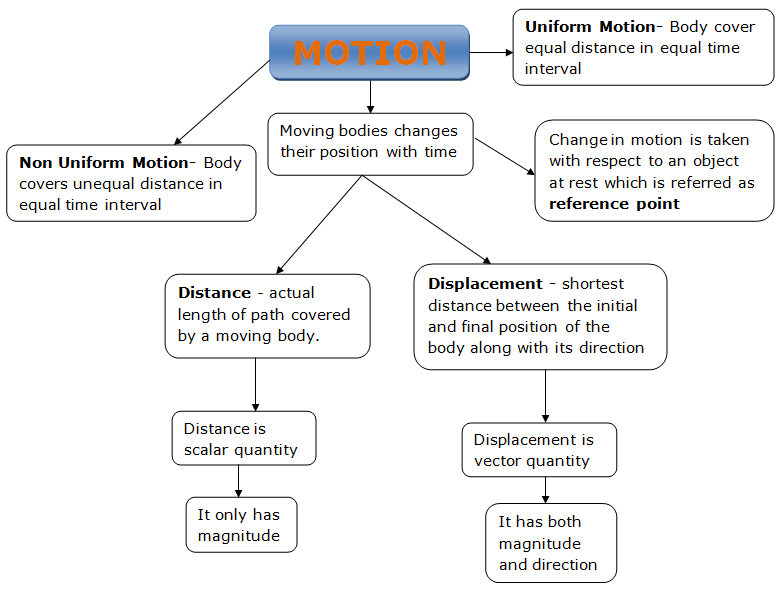
An object is said to be in motion if its position with respect to a reference point changes with time. If the position does not change with time, the object is said to be at rest.
In our daily life, we see many things moving — a car passing from one place to another, a person riding a bicycle, and many more.
In scientific terms, an object is said to be in motion if it changes its position with the passage of time, and at rest if it does not change its position.
Both motion and rest are relative terms. For example, a mobile kept on a table is at rest with respect to the table, but it is moving with respect to an observer on the Moon (because the Earth is rotating).
The simplest kind of motion is linear motion — also called motion in a straight line or rectilinear motion.
In our description of motion, we treat the object as a point object when its size is much smaller than the distance it travels.
Direction Convention for Linear Motion
For an object moving in a straight line, direction is represented by plus (+) and minus (–) signs. Positions to the right of the reference point are taken as positive and positions to the left are taken as negative. Once chosen, this convention must not be changed while solving a problem.
Concept Map of Motion
Motion in nature can be broadly classified as follows:
Type of Motion
Description
Examples
Linear Motion (1D)
Motion along a straight line
Falling ball, car on a highway
Circular Motion (2D)
Motion along a circular path
Merry-go-round, satellite orbiting Earth
Oscillatory Motion
Back-and-forth motion about a fixed point
Pendulum, guitar string
NCERT Fig. 4.1: Objects in straight line motion — swimming race, falling ball, car on highway, train on track
Section 1: Describing Position
To discuss the motion of an object, we must first describe its position at various instants of time.
Term
Definition
Reference Point
A fixed point with respect to which the position of an object is described.
Origin (O)
The reference point marked on a number line. It is the starting point of measurement.
Position of an Object
The distance and direction of the object with respect to the reference point at any given instant of time.
Important Note
An instant of time and a time interval are not the same thing. An instant of time is a single reading of a clock at a given point of time. A time interval is the time duration between two instants of time, i.e., between two clock readings.
Consider the example of an athlete Neena running on a straight track. Let her starting point be the origin O. Her positions at different instants are marked on a number line, with positive direction to the right and negative to the left.
NCERT Fig. 4.3: Reference point and positions of the athlete at different instants on a straight line
Section 2: Distance and Displacement
Two different quantities are used to describe the overall motion of an object and to locate its final position with reference to its initial position.
Distance: The total length of the path described by a moving object. It is independent of direction. Distance is always positive and can never be zero for a moving object.
Displacement: The net change in the position of an object between two given instants of time. It requires both a direction and a numerical value (magnitude) for complete description.
Suppose an athlete starts from origin O, reaches point A (100 m) at t = 10 s, then runs back to point B (40 m) at t = 16 s.
Total distance travelled = OA + AB = 100 m + 60 m = 160 m
Displacement = OB = 40 m in the positive direction = 40 m (positive direction)
The distance travelled and the magnitude of displacement are equal only when the object moves in one direction without turning back.
The distance travelled by a moving body cannot be zero, but the final displacement of a moving body can be zero (e.g., when an athlete returns to the starting point).
NCERT Fig. 4.4: Reference point and positions of athlete at different instants of time showing distance ≠ displacement
Key Difference: Distance vs Displacement
Property
Distance
Displacement
Type of quantity
Scalar
Vector
Direction required?
No
Yes
Can it be zero?
No (for a moving body)
Yes (when start = end point)
Magnitude relation
Always ≥ |displacement|
Always ≤ distance
SI Unit
metre (m)
metre (m)
4.1 Activity 4.1: Let Us Analyse — Distance and Displacement of a Ball
A ball is thrown vertically upwards from O. It moves up to point B (140 cm above O) and then falls back to O. Analyse the distance travelled and displacement at each position.
1. ______________ and ______________ are used to describe the overall motion of an object and to locate its final position. 2. Physical quantities that do not require direction for their complete description are called ______________. 3. When a body moves from one position to another, the shortest distance between the initial and final positions along with its direction is called ______________. 4. The distance travelled by a moving body cannot be zero, but the final ______________ of a moving body can be zero. 5. Displacement has both direction and magnitude and is hence a ______________ quantity. Check Answers
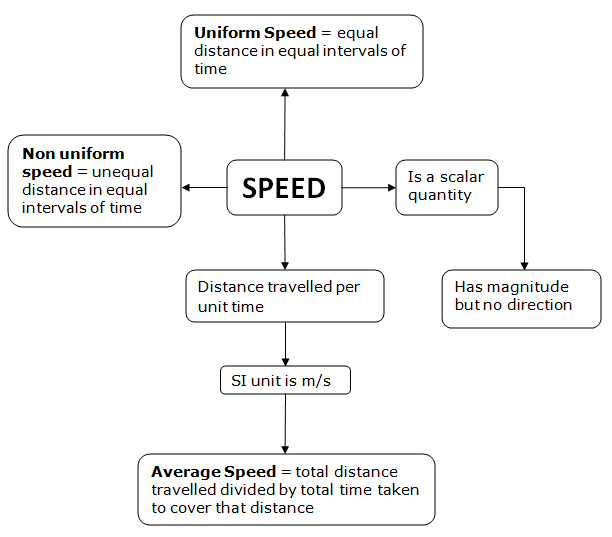
Speed tells us how fast or slow an object moves. The average speed of an object is the total distance travelled divided by the time interval during which this distance is covered.
Since distance has no direction, average speed is a scalar quantity — it has only a numerical value, no direction.
If an object travels equal distances in equal intervals of time, it is said to be in uniform motion. It moves at a constant speed.
If an object travels unequal distances in equal intervals of time, it is in non-uniform motion. Its speed is changing.
SI unit of average speed: metre per second (m s⁻¹ or m/s). It is also expressed as km h⁻¹.
Concept Map of Speed
Average Velocity
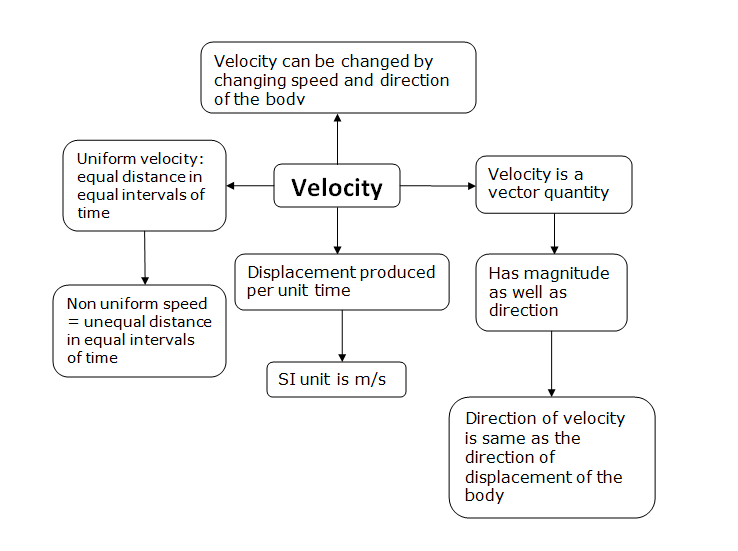
Average velocity describes how fast the position of an object is changing, and in which direction. The average velocity of an object in a time interval is the change in position (displacement) divided by the time interval.
Average velocity is a vector quantity — direction is indicated by a '+' or '–' sign (same as the direction of displacement).
Average velocity is the average rate of change of position of an object with respect to time.
The average speed and magnitude of average velocity in a time interval are equal only if the object moves in one direction.
When velocity changes at a uniform rate, the average velocity is:
$$\text{Average Velocity} = \frac{u + v}{2}$$
where $u$ is the initial velocity and $v$ is the final velocity.
Worked Example (from NCERT)
Example 4.2: Sarang takes 50 seconds to swim from one end of a 25 m swimming pool to the other end and back. Find his average speed and average velocity.
Show Solution
Total distance travelled = 50 m
Displacement in 50 s = 0 m (returns to starting point)
The concept that speed is distance divided by time dates back to ancient India. It is seen in the treatise Aryabhatiya (5th century CE). A related problem appears in the Ganitakaumudi (14th century CE): two postmen start walking towards each other from 210 yojanas apart, one covering 9 yojanas per day and the other 5 yojanas per day. They meet after 15 days — a direct application of the average speed formula.
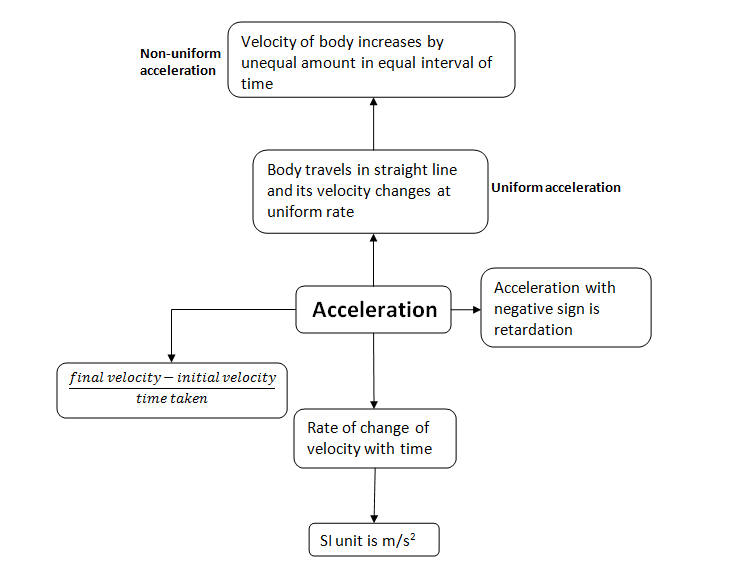
SI unit of average acceleration: metre per second squared (m s⁻² or m/s²).
Like displacement and velocity, acceleration is a vector quantity — direction matters.
If the magnitude of velocity is increasing, the average acceleration is in the same direction as velocity.
If the magnitude of velocity is decreasing, the average acceleration is opposite to the direction of velocity (also called retardation or negative acceleration).
If the velocity increases or decreases by equal amounts in equal intervals of time, the acceleration is constant.
A body has non-uniform acceleration if its velocity increases or decreases by unequal amounts in equal intervals of time.
Important Concept
An object can be moving very fast and yet have zero acceleration. Acceleration depends not on how fast an object is moving, but on how quickly its velocity is changing. A bus moving on a straight highway at constant velocity has zero acceleration, even if it is moving at high speed.
Worked Example (from NCERT)
Example 4.3: A bus moves at 36 km h⁻¹. The driver presses the accelerator for 10 s and velocity increases to 54 km h⁻¹. Later, the driver brakes and the bus stops in 5 s. Find the average acceleration in both cases.
Show Solution
(i) When accelerator is pressed:
$u = 36 \text{ km h}^{-1} = 10 \text{ m s}^{-1}$, $v = 54 \text{ km h}^{-1} = 15 \text{ m s}^{-1}$, $t = 10$ s
$$a = \frac{15 - 10}{10} = 0.5 \text{ m s}^{-2}$$ (positive — in the direction of motion)
(ii) When brakes are applied:
$u = 15 \text{ m s}^{-1}$, $v = 0 \text{ m s}^{-1}$, $t = 5$ s
$$a = \frac{0 - 15}{5} = -3 \text{ m s}^{-2}$$ (negative — opposite to the direction of motion)
4.2 Activity 4.2: Let Us Calculate — Average Acceleration of Cars
Look up on the internet the time taken by various cars to go from 0 to 100 km h⁻¹, and calculate their average acceleration in m s⁻².
Test Your Knowledge — Speed, Velocity and Acceleration
Fill in the Blanks
1. ______________ is defined as the total distance travelled by the object in the time interval during which the motion takes place. 2. The rate of change of displacement of an object with the passage of time is known as ______________ of the object. 3. Velocity of a body is a ______________ quantity involving both distance and displacement, whereas speed of a body is a ______________ quantity. 4. Acceleration is a measure of the change in ______________ of an object per unit time. 5. If acceleration is in the direction of the velocity, it is ______________ acceleration; if it is opposite, it is called ______________.
True or False
1. A body has uniform acceleration if its velocity increases by equal amounts in equal intervals of time moving in a straight line. 2. The odometer in a car measures the velocity of the car. 3. When velocity of the object changes at a uniform rate, average velocity = (u + v) / 2. 4. An object moving at very high speed always has large acceleration. Check Answers
Fill in the Blanks:
1. Speed 2. Velocity 3. Vector, Scalar 4. Velocity 5. Positive, Retardation (negative acceleration)
True or False:
1. True 2. False (odometer measures distance, speedometer measures speed) 3. True 4. False (acceleration depends on change in velocity, not the speed itself)
Graphs provide a visual representation of how position, velocity and acceleration change with time. They help in comparing motion of two objects, calculating physical quantities, and identifying whether motion is uniform or non-uniform.
Note
All graphs discussed in this chapter are for motion in a straight line in one direction only. In this special case, distance = magnitude of displacement, and speed = magnitude of velocity. A graph is not a route map — it shows how the position of an object changes with time, not the route taken.
5.1 Position-Time Graph
In a position-time graph, time is taken along the x-axis and position is taken along the y-axis.
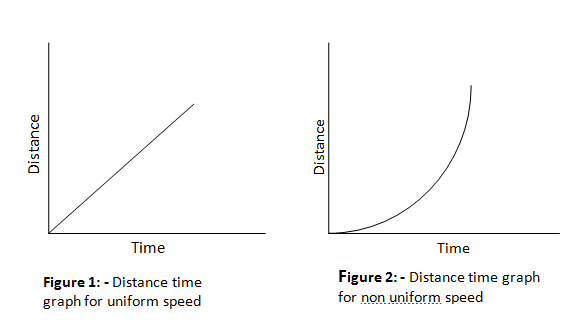
A straight line position-time graph indicates that the object is moving with constant velocity (uniform motion).
A curved position-time graph indicates that the velocity is not constant — the object is in accelerated motion.
A straight line parallel to the time axis indicates the object is at rest (position not changing with time).
The slope of a position-time graph gives the magnitude of average velocity:
$$v = \frac{s_2 - s_1}{t_2 - t_1} = \frac{BC}{CA} = \text{slope of line AB}$$
A steeper slope on the position-time graph means a higher velocity.
In a velocity-time graph, time is taken along the x-axis and velocity along the y-axis.
A straight line parallel to the time axis indicates constant velocity (acceleration = 0).
A straight line going upward indicates velocity is increasing with constant acceleration (in the direction of velocity).
A straight line going downward indicates velocity is decreasing with constant acceleration (opposite to velocity).
The slope of the velocity-time graph gives acceleration:
$$a = \frac{v - u}{t_2 - t_1} = \frac{BC}{CA} = \text{slope of velocity-time graph}$$
The area enclosed between the velocity-time graph and the time axis gives the displacement:
For a rectangle: $\text{displacement} = \text{velocity} \times \text{time interval}$
For a trapezium: $\text{displacement} = \text{area of rectangle} + \text{area of triangle}$
Section 6: Kinematic Equations for Motion in a Straight Line
For an object moving in a straight line with constant acceleration, five physical quantities — displacement ($s$), time interval ($t$), initial velocity ($u$), final velocity ($v$) and acceleration ($a$) — can be related by the following set of equations, known as kinematic equations:
First Equation (velocity-time):
$$v = u + at$$
Second Equation (position-time):
$$s = ut + \frac{1}{2}at^2$$
Third Equation (position-velocity):
$$v^2 = u^2 + 2as$$
What Each Equation Gives
First equation ($v = u + at$): Gives the velocity acquired by a body at any time $t$. Derived from the definition of acceleration.
Second equation ($s = ut + \frac{1}{2}at^2$): Gives the distance travelled by a body in time $t$. Derived from area under the velocity-time graph.
Third equation ($v^2 = u^2 + 2as$): Gives the velocity acquired by a body in travelling a distance $s$. Derived by eliminating $t$ from the first two equations.
6.1 Derivation of Kinematic Equations by Graphical Method
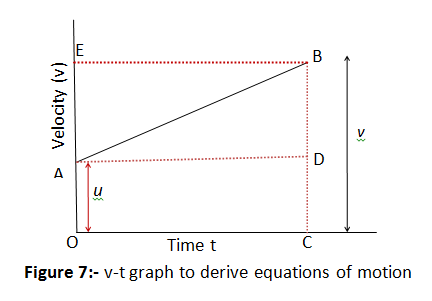
The three kinematic equations can be derived using the velocity-time graph for an object moving with uniform acceleration. Consider the graph shown below, where the initial velocity is $u$ (at point A) and the final velocity after time $t$ is $v$ (at point B).
NCERT Fig. 4.19: Velocity-time graph with initial velocity u, final velocity v, used to derive all three kinematic equations
a. First Equation: $v = u + at$ (velocity-time relation)
From the graph, $BC = BD + DC = BD + OA$, so $v = BD + u$ ...(1)
Acceleration from the graph: $a = \frac{\text{change in velocity}}{\text{time}} = \frac{BD}{OC} = \frac{BD}{t}$
Therefore $BD = at$
Substituting in (1): $$\boxed{v = u + at}$$
b. Second Equation: $s = ut + \frac{1}{2}at^2$ (position-time relation)
The displacement $s$ in time $t$ = area enclosed by the trapezium OABC under the velocity-time graph AB.
$s = \text{area of rectangle OADC} + \text{area of triangle ABD}$
$s = (OA \times OC) + \frac{1}{2}(AD \times BD)$
Substituting $OA = u$, $OC = AD = t$ and $BD = at$:
$$s = u \times t + \frac{1}{2} \times t \times at$$
$$\boxed{s = ut + \frac{1}{2}at^2}$$
c. Third Equation: $v^2 = u^2 + 2as$ (position-velocity relation)
The displacement $s$ is also given by the area of trapezium OABC:
$$s = \frac{(OA + CB) \times OC}{2} = \frac{(u + v) \times t}{2}$$
From the first equation, $t = \frac{v - u}{a}$. Substituting:
$$s = \frac{(u + v)}{2} \times \frac{(v - u)}{a} = \frac{v^2 - u^2}{2a}$$
Rearranging: $$\boxed{v^2 = u^2 + 2as}$$
Useful Tips for Solving Problems
If a body starts moving from rest: initial velocity $u = 0$
If a body comes to a stop: final velocity $v = 0$
If a body moves with uniform velocity: acceleration $a = 0$
Always convert units to SI before substituting (km h⁻¹ → m s⁻¹ by dividing by 3.6)
Conditions of Validity
These kinematic equations are valid only when the acceleration is constant.
If a body starts from rest: initial velocity $u = 0$
If a body comes to rest: final velocity $v = 0$
If a body moves with uniform velocity: acceleration $a = 0$
The sign of $u$, $v$, $a$ and $s$ tells us about the direction of that quantity.
Worked Example — Braking Distance (Example 4.8)
Problem: A car is moving on a highway and brakes are applied, causing an acceleration of $-4 \text{ m s}^{-2}$. How much distance does the car travel before stopping if its initial velocity is (i) 54 km h⁻¹, and (ii) 108 km h⁻¹?
Show Solution
Given: $a = -4 \text{ m s}^{-2}$, $v = 0 \text{ m s}^{-1}$
Using $v^2 = u^2 + 2as$:
$(0)^2 = u^2 + 2 \times (-4) \times s \Rightarrow s = \frac{u^2}{8}$
(ii) $u = 108 \text{ km h}^{-1} = 30 \text{ m s}^{-1}$: $s = \frac{30^2}{8} = \frac{900}{8} = \mathbf{112.5 \text{ m}}$
Key Insight: When the speed doubles, the braking distance becomes four times larger! This directly answers the "Think It Over" question from the beginning of the chapter.
Bridging Science and Society — Safe Driving Distance
When brakes are applied, a vehicle travels some distance before stopping (braking distance). This depends on: the initial velocity, road surface conditions, braking capacity of the vehicle, and the driver's reaction time. As shown above, doubling the speed quadruples the braking distance. This is why speed limits and safe following distances are enforced on roads. A Vehicle-to-Vehicle (V2V) communication technology, now being developed in India and many countries, allows vehicles to exchange signals and warn drivers of possible collisions.
NCERT Fig. 4.20: Safe distance between two moving vehicles — application of kinematic equations
Test Your Knowledge — Graphs and Equations of Motion
Fill in the Blanks
1. The three equations of uniformly accelerated motion are ______________, ______________ and ______________. 2. The change in position of an object with time can be represented on the ______________ graph. 3. The slope of a velocity-time graph gives the ______________ of the object. 4. The area enclosed by the velocity-time graph and the time axis gives the ______________ of the object. 5. The distance-time graph for a body moving with non-uniform speed is a ______________. 6. If a body moves with constant velocity, the velocity-time graph is a straight line ______________ to the time axis. Check Answers
1. v = u + at | s = ut + ½at² | v² = u² + 2as
2. Position-time (distance-time)
3. Acceleration
4. Displacement
5. Curve
6. Parallel
Till now, we discussed motion in a straight line (motion in one dimension). Let us now explore motion in a plane (motion in two dimensions).
When an object moves in a circular path with constant (uniform) speed, its motion is called uniform circular motion.
In one revolution, the distance travelled = circumference of the circle = $2\pi R$.
The displacement after one complete revolution = 0 (object returns to starting point).
If the object takes time $T$ to complete one revolution, its average speed is:
$$v_{av} = \frac{2\pi R}{T} \quad \text{...(Eq. 4.5)}$$
The average velocity during one complete revolution = 0 (since displacement = 0).
In uniform circular motion, speed is constant at every point, but the direction of velocity changes continuously (velocity is always tangent to the circle at that point).
Since velocity (direction) is changing, uniform circular motion is an accelerated motion, even though speed is constant.
Common Misconception
In everyday life, we say a vehicle is "accelerating" only when its speed increases. However, acceleration can occur when there is only a change in the direction of velocity, even if speed stays constant. Uniform circular motion is accelerated motion due to the continuous change in direction of velocity.
Examples of Uniform Circular Motion
Motion of artificial satellites around the Earth
Moon (natural satellite) moving around the Earth
A cyclist moving on a circular track at constant speed
Motion of planets revolving around the Sun (approximate)
NCERT Fig. 4.23: An athlete running along (a) rectangular track, (b) hexagonal track, (c) circular track — showing how direction of velocity changes
4.5 Activity 4.5: Let Us Investigate — Marble Inside a Ring
A marble is made to rotate along the inner boundary of a ring. When the ring is lifted while the marble is moving, the marble moves in a straight line. This shows that in uniform circular motion, velocity at any instant is directed along the tangent to the circular path.
Scalar vs Vector
Scalars: distance, speed. Vectors: displacement, velocity, acceleration. Vectors need both magnitude and direction. More →
Rate of Change
The ratio of change in one quantity to the corresponding change in time. Average velocity = rate of change of position. Average acceleration = rate of change of velocity. More →
Instantaneous vs Average
Average values are over a time interval. Instantaneous values are at a single instant. Speedometer reads near-instantaneous speed. More →
Magnitude
The numerical value (with units) of a physical quantity. For displacement, the magnitude is the straight-line distance between start and end points.
Chapter Summary Table
Quantity
Symbol
Formula
SI Unit
Scalar / Vector
Distance
$d$
Length of path
metre (m)
Scalar
Displacement
$s$
Change in position
metre (m)
Vector
Average Speed
—
$\frac{\text{total distance}}{\text{time}}$
m s⁻¹
Scalar
Average Velocity
$v_{av}$
$\frac{s}{\Delta t}$
m s⁻¹
Vector
Average Acceleration
$a$
$\frac{v - u}{\Delta t}$
m s⁻²
Vector
Slope of s-t graph
—
$\frac{\Delta s}{\Delta t}$
—
= Velocity
Slope of v-t graph
—
$\frac{\Delta v}{\Delta t}$
—
= Acceleration
Speed in Circular Motion
$v_{av}$
$\frac{2\pi R}{T}$
m s⁻¹
Scalar (magnitude)
Quick Revision Points (At a Glance)
The distance and direction of an object with respect to a reference point, at any instant, describes its position.
If the position of an object changes with respect to a reference point, the object is said to be in motion.
Displacement is the net change in the position of an object between two given instants of time.
The average speed of an object is the total distance travelled divided by the time interval.
The average velocity is the change in position (displacement) divided by the time interval. It is a vector.
The average acceleration is the change in velocity divided by the time interval. SI unit is m s⁻².
The slope of a position-time graph gives the magnitude of velocity.
The slope of a velocity-time graph gives acceleration.
The area under the velocity-time graph (with the time axis) gives displacement.
For constant acceleration, the kinematic equations are: $v = u + at$, $s = ut + \frac{1}{2}at^2$, $v^2 = u^2 + 2as$.
When an object moves in a circular path with constant speed, its motion is called uniform circular motion.
Uniform circular motion is accelerated motion because the direction of velocity changes continuously, even though speed is constant.
An object is said to be in motion if its position changes with respect to a reference point with the passage of time. If the position does not change, the object is at rest. Both motion and rest are relative terms — an object at rest with respect to one observer may be in motion with respect to another.
Q2. What is displacement in Class 9?
Displacement is the net change in the position of an object between two given instants of time. It is a vector quantity requiring both magnitude and direction. Its SI unit is metre (m). The magnitude of displacement is always less than or equal to the total distance travelled.
Q3. What is the difference between speed and velocity?
Speed is a scalar quantity — it is the total distance travelled divided by the time interval and has no direction. Velocity is a vector quantity — it is the displacement divided by the time interval and has both magnitude and direction. For motion in one direction, speed and magnitude of velocity are equal. Learn more →
Q4. What is average acceleration in Class 9?
Average acceleration is the change in velocity of an object divided by the time interval: $a = \frac{v - u}{t}$. Its SI unit is m s⁻². If velocity is increasing, acceleration is in the direction of velocity. If velocity is decreasing, acceleration is opposite to the direction of velocity (also called retardation).
These are valid only when acceleration is constant. They relate the five quantities: displacement ($s$), time ($t$), initial velocity ($u$), final velocity ($v$) and acceleration ($a$).
Q6. What is uniform circular motion?
When an object moves in a circular path with constant (uniform) speed, its motion is called uniform circular motion. Though speed is constant, the direction of velocity changes continuously, making it an accelerated motion. The average speed is given by $v_{av} = \frac{2\pi R}{T}$. Examples: artificial satellites, Moon around Earth.