
Chapter 4 of Class 11 Physics — Laws of Motion — is one of the most important chapters in mechanics. A solid grasp of Newton’s Laws, momentum, friction, and circular motion is essential before moving ahead in the syllabus.
To help you check your preparation, I have designed a 30-mark practice test covering all key topics from this chapter: impulse, conservation of linear momentum, static and kinetic friction, and dynamics of circular motion (level and banked roads).
This is a 1-hour test paper with multiple-choice questions, conceptual questions, a case-study based question, and derivations. Set a timer for one hour and attempt it seriously to test your preparation.
Topics Covered in This Laws of Motion Test
- Newton’s first, second, and third laws of motion
- Linear momentum and conservation of linear momentum
- Impulse and impulsive force
- Equilibrium of concurrent forces
- Static friction and kinetic friction (laws of friction)
- Rolling friction and lubrication
- Circular motion: centripetal force
- Motion on a level road
- Motion on a banked road
Class 11 Physics Laws of Motion Test Paper (30 Marks)
Time Allowed: 1 Hour | Total Marks: 30 Topics Covered: Chapter–5: Laws of Motion (Newton’s Laws, momentum, impulse, conservation of linear momentum, concurrent forces, static and kinetic friction, dynamics of circular motion, level and banked roads)
SECTION A: 1-Mark Questions (Conceptual and Numerical)
(Answer all questions. Each question carries 1 mark. Select the correct option.)

Q1. Which of the following is known as the law of inertia?
(A) Newton’s first law of motion
(B) Newton’s second law of motion
(C) Newton’s third law of motion
(D) Law of conservation of mass
Answer
(A) Newton’s first law of motion
Reasoning: Newton’s first law states that an object will remain at rest or in uniform motion unless acted upon by an external force, which is the exact definition of inertia.
Q2. A car moves at a speed of 20 m/s on a banked road and describes an arc of a circle of radius $40\sqrt{3}$ m. The angle of banking in degrees is (g = 10 m/s²):
(A) 25
(B) 60
(C) 30
(D) 45
Answer
(C) 30
Solution:
The formula for the angle of banking is $\tan(\theta) = \frac{v^2}{rg}$
Substitute the given values ($v = 20$ m/s, $r = 40\sqrt{3}$ m, $g = 10$ m/s²):
$\tan(\theta) = \frac{20^2}{(40\sqrt{3})(10)}$
$\tan(\theta) = \frac{400}{400\sqrt{3}} = \frac{1}{\sqrt{3}}$
Since $\tan(30^\circ) = \frac{1}{\sqrt{3}}$, the angle $\theta$ is $30^\circ$.
Q3. Sand is being dropped on a conveyor belt at the rate of M kg/s. The force necessary to keep the belt moving with a constant velocity v m/s will be:
(A) Mv
(B) 2 Mv
(C) Mv/2
(D) zero
Answer
(A) Mv
Solution:
According to Newton’s second law, Force $F = \frac{dp}{dt} = \frac{d(mv)}{dt}$.
Since the velocity $v$ is constant, we can rewrite this as $F = v\frac{dm}{dt}$.
We are given that the rate of change of mass $\frac{dm}{dt} = M$.
Therefore, $F = v \times M = Mv$.
Q4. The proper use of lubricants cannot reduce:
(A) Static friction
(B) Inertia
(C) Sliding friction
(D) Rolling friction
Answer
(B) Inertia
Reasoning: Lubricants reduce physical contact between surfaces, which reduces friction (static, sliding, and rolling). Inertia depends strictly on the mass of the object and has nothing to do with friction or lubrication.
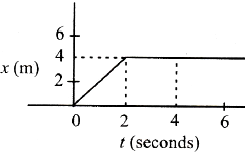
Q5. In the figure given, the position-time graph of a particle of mass 0.1 kg is shown. The impulse at t = 2s is:
(A) 0.2 kg–m/s
(B) -0.2 kg–m/s
(C) 0.1 kg–m/s
(D) -0.4 kg–m/s
SECTION B: 2-Mark Questions (Conceptual)
(Answer all questions. Each question carries 2 marks.)
Q6. What do you understand by impulse? Use it to explain why a cricket player lowers his hands while catching a ball.
Answer
Impulse is defined as the change in momentum of a body, or the product of the average force applied and the time interval over which it acts ($\text{Impulse} = F_{avg} \times \Delta t = \Delta p$).
When a cricket player lowers his hands while catching a ball, he increases the time interval ($\Delta t$) over which the high-speed ball comes to rest. Since the total change in momentum ($\Delta p$) of the ball is fixed, increasing the time interval reduces the average impact force ($F = \frac{\Delta p}{\Delta t}$) exerted on his hands, thereby preventing injury.
Q7. Explain why static friction is called a self-adjusting force.
Answer
Static friction is called a self-adjusting force because it can adjust both its magnitude and direction to exactly oppose the applied external force, keeping the object at rest. It scales up as the applied force increases, up to a certain maximum limit known as “limiting friction”. As long as the applied force is less than the limiting friction, the static friction force will automatically match it perfectly.
SECTION C: 3-Mark Questions (Conceptual, Derivation, and Numerical)
(Answer all questions. Each question carries 3 marks.)
Q8. Why does a cyclist lean inward when moving along a curved path? Determine the angle through which the cyclist bends from the vertical to negotiate a curve.
Answer
A cyclist leans inward while taking a turn so that the horizontal component of the normal reaction from the ground can provide the necessary centripetal force required to move in a curved path.
Derivation:
Let a cyclist of total mass $m$ bend at an angle $\theta$ with the vertical while traveling with velocity $v$ on a curve of radius $r$. The normal reaction $R$ of the ground acts along the leaning cyclist and can be resolved into two components:
- Vertical component ($R \cos\theta$) balances the weight of the cyclist: $R \cos\theta = mg$
- Horizontal component ($R \sin\theta$) provides the necessary centripetal force: $R \sin\theta = \frac{mv^2}{r}$
Dividing equation 2 by equation 1:
$\frac{R \sin\theta}{R \cos\theta} = \frac{\frac{mv^2}{r}}{mg}$
$\tan\theta = \frac{v^2}{rg}$
Therefore, the angle of bending is $\theta = \tan^{-1}\left(\frac{v^2}{rg}\right)$.
Q9. A bullet of mass 100g moving with 20 m/s strikes a wooden plank and penetrates up to 20 cm. Calculate the resistance (reaction force) offered by the wooden plank.
Answer
Given:
Mass $m = 100\text{ g} = 0.1\text{ kg}$
Initial velocity $u = 20\text{ m/s}$
Final velocity $v = 0\text{ m/s}$ (since it stops)
Distance $s = 20\text{ cm} = 0.2\text{ m}$
Using the third equation of motion: $v^2 – u^2 = 2as$
$0^2 – (20)^2 = 2 \times a \times 0.2$
$-400 = 0.4a$
$a = -1000\text{ m/s}^2$ (The negative sign indicates deceleration)
Resistance force $F = m \times \vert{}a\vert{}$
$F = 0.1 \times 1000 = 100\text{ N}$
The resistance force offered by the plank is 100 N.
Q10. Find the maximum speed at which a car can take turns around a curve of a 30m radius on a level road, if the coefficient of friction between tires and road is 0.4.
Answer
Given: $r = 30\text{ m}$, $\mu = 0.4$, $g = 9.8\text{ m/s}^2$ (or $10\text{ m/s}^2$)
The formula for the maximum safe speed on a level curve is $v_{max} = \sqrt{\mu rg}$
$v_{max} = \sqrt{0.4 \times 30 \times 9.8}$
$v_{max} = \sqrt{117.6} \approx 10.84\text{ m/s}$
(Note: If you use $g = 10\text{ m/s}^2$, $v_{max} = \sqrt{120} \approx 10.95\text{ m/s}$)
Q11. A vehicle is moving on a horizontal road with speed v. If the coefficient of friction between the tyres and the road is ?, show that the shortest distance in which the vehicle can be stopped is $s=\frac{v^{2}}{2\mu g}$.
Answer
Initial velocity = $v$, Final velocity = $0$
When the brakes are fully applied, the maximum retarding force acting on the vehicle is the kinetic friction:
$F = \mu N = \mu mg$
Therefore, the deceleration $a$ is:
$a = \frac{-F}{m} = \frac{-\mu mg}{m} = -\mu g$
Using the third equation of motion: $v_f^2 – v_i^2 = 2as$
$0^2 – v^2 = 2(-\mu g)s$
$-v^2 = -2\mu gs$
$s = \frac{v^2}{2\mu g}$ (Hence proved).
SECTION D: 4-Mark Case-Study Based Question
(Read the text carefully and answer the questions that follow. Each sub-question carries 1 mark.)
Q12. When a car negotiates a curved road, the force of friction between the road and the tyres provides the centripetal force required to keep the car in motion around the curve. A large amount of friction between the tyres and the road produces considerable wear and tear on the tyres. To avoid dependence on friction, the curved road is given an inclination sloping upwards towards the outer circumference. This reduces the wearing of the tyres because the horizontal component of the normal reaction provides the necessary centripetal force. The system of raising the outer edge of a curved road above the inner edge is called the banking of the curved road. The maximum safe velocity of a vehicle on a banked road depends on the radius of the turn, acceleration due to gravity, the angle of banking, and the coefficient of friction between the tyres and the road.
(i) If the radii of circular paths of two particles of the same mass are in the ratio of 16:25, then to have a constant centripetal force, their velocities should be in a ratio of:
(A) 3:2
(B) 4:1
(C) 4:5
(D) 2:3
Answer
(C) 4:5
Reasoning: Centripetal force $F_c = \frac{mv^2}{r}$. For force and mass to be constant, $v^2 \propto r$.
$\frac{v_1^2}{v_2^2} = \frac{r_1}{r_2} = \frac{16}{25} \implies \frac{v_1}{v_2} = \frac{4}{5}$.
(ii) The maximum speed with which a car can be driven round a curve of radius 16m without skidding (when g = 10 m/s² and the coefficient of friction between rubber tyres and the roadway is 0.4) is:
(A) 8 m/s
(B) 10 m/s
(C) 6 m/s
(D) 4 m/s
Answer
(A) 8 m/s
Reasoning: $v = \sqrt{\mu rg} = \sqrt{0.4 \times 16 \times 10} = \sqrt{64} = 8$ m/s.
(iii) A body moves along a circular path of radius 1m and the coefficient of friction is 0.225. What should be its angular speed in rad/s if it is not to slip from the surface (take g = 10 m/s²)?
(A) 1.5 rad/s
(B) 0.5 rad/s
(C) 3.5 rad/s
(D) 2.0 rad/s
Answer
(A) 1.5 rad/s
Reasoning: Linear speed $v = \sqrt{\mu rg}$. We know $v = r\omega$, so $r\omega = \sqrt{\mu rg} \implies \omega = \sqrt{\frac{\mu g}{r}}$.
$\omega = \sqrt{\frac{0.225 \times 10}{1}} = \sqrt{2.25} = 1.5$ rad/s.
(iv) The force which is acting as a centripetal force when a vehicle takes a circular turn on a level road is:
(A) Normal reaction
(B) Frictional force
(C) Components of normal force
(D) None of the above
Answer
(B) Frictional force
SECTION E: 5-Mark Question (Derivation)
(This question carries 5 marks.)
Q13. What is meant by the banking of roads? Explain the need for it. Obtain an expression for the maximum speed with which a vehicle can safely negotiate a curved road banked at angle ?. The coefficient of friction between the road and wheels is ?.
Answer
Banking of roads: The process of raising the outer edge of a curved road slightly higher than the inner edge is called the banking of roads.
Need for banking: On a flat curved road, a vehicle relies entirely on the friction between its tires and the road to provide the required centripetal force for a turn. This is unsafe because friction can decrease significantly (e.g., if the road is wet or tires are worn out), leading to fatal skids. Banking tilts the normal reaction of the road so that its horizontal component naturally helps supply the required centripetal force, reducing reliance on friction.
Expression for maximum safe speed:
Let a vehicle of mass $m$ be moving with maximum safe speed $v$ on a curved road of radius $r$, banked at an angle $\theta$. The coefficient of static friction is $\mu$.
The forces acting on the vehicle are:
- Weight ($mg$) downwards.
- Normal reaction ($N$) perpendicular to the banked road.
- Frictional force ($f = \mu N$) acting downwards along the incline (to prevent the vehicle from skidding outwards at maximum speed).
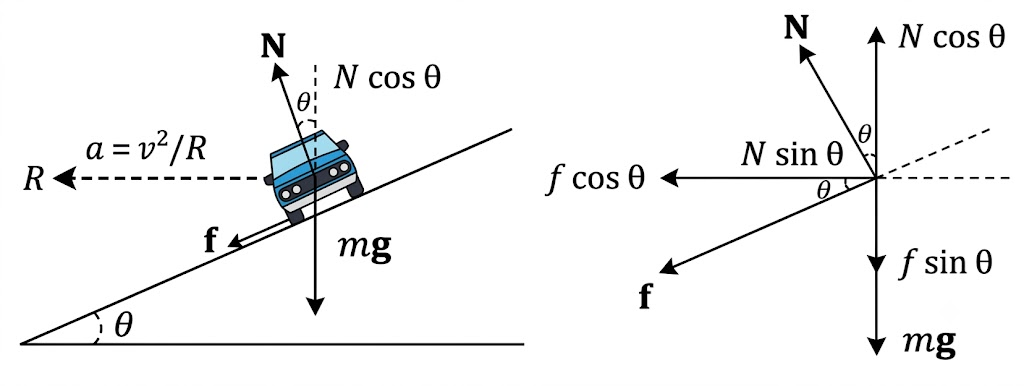
Resolving $N$ and $f$ into horizontal and vertical components:
- Vertical equilibrium: The vertical component of the normal reaction supports both the weight of the car and the downward vertical component of friction.
$N \cos\theta = mg + f \sin\theta$
$mg = N \cos\theta – \mu N \sin\theta$
$mg = N(\cos\theta – \mu \sin\theta)$ — (Equation 1) - Horizontal centripetal force: Both the horizontal component of the normal reaction and the horizontal component of friction provide the required centripetal force ($\frac{mv^2}{r}$).
$\frac{mv^2}{r} = N \sin\theta + f \cos\theta$
$\frac{mv^2}{r} = N(\sin\theta + \mu \cos\theta)$ — (Equation 2)
Divide Equation 2 by Equation 1:
$\frac{\frac{mv^2}{r}}{mg} = \frac{N(\sin\theta + \mu \cos\theta)}{N(\cos\theta – \mu \sin\theta)}$
$\frac{v^2}{rg} = \frac{\sin\theta + \mu \cos\theta}{\cos\theta – \mu \sin\theta}$
Divide the numerator and the denominator of the right side by $\cos\theta$:
$\frac{v^2}{rg} = \frac{\tan\theta + \mu}{1 – \mu \tan\theta}$
Rearranging for $v$:
$v_{max} = \sqrt{rg \left[ \frac{\mu + \tan\theta}{1 – \mu \tan\theta} \right]}$
Tips to Ace Physics Numericals on Friction and Circular Motion
Most students lose marks in this chapter not because the concepts are hard, but because they skip the first step:- drawing a proper Free Body Diagram (FBD).
Before writing any equation, mark all the forces acting on the object — weight, normal reaction, friction, and tension (if any) — with correct direction and point of application. Once the FBD is ready, resolve each force into horizontal and vertical components along a convenient axis.
For circular motion problems (level road, banked road, or a body on a rotating platform), it helps to take one axis along the direction of the centripetal acceleration and the other perpendicular to it. This makes it straightforward to write the net force along the centripetal direction as $mv^2/r$, and the net force in the perpendicular direction as zero (since there is no acceleration in that direction).
Also remember: friction is self-adjusting and acts only up to its maximum limit $\mu N$. Don’t assume friction is always at its maximum value unless the question specifies the body is on the verge of slipping.
Download this as PDF