
Sound Is Observed Only When Something Moves
We notice a clear pattern in daily life:
- Clapping hands produces sound
- Striking a bell produces sound
- Plucking a guitar string produces sound
However, when these objects are at rest, no sound is heard. A bell kept untouched or a book lying still on a table remains silent.
This leads to an important question: why is sound heard only when there is motion?
Vibration Is the Root Cause of Sound
Careful observation shows that whenever sound is produced, the object involved is not just moving, but moving to and fro.
- A guitar string moves back and forth
- A bell vibrates when struck
- Vocal cords vibrate when we speak
This repeated back-and-forth motion is called vibration.
Hence, sound is always associated with vibrating objects.
Students studying this topic in detail should first go through the complete Class 9 sound theory notes available here:
? Sound Class 9 Notes
Why Do Vibrations Produce Sound?

To understand this, we must look at how sound travels.
Sound is a form of mechanical energy that travels through a material medium like air in the form of waves. For a sound wave to form, the surrounding air must be disturbed repeatedly. This disturbance is created only by vibrations.
This concept forms the foundation of the chapter Sound, which is covered in detail on the main Class 9 Sound chapter hub.
How a Vibrating Object Produces Sound Waves
Consider a vibrating tuning fork.
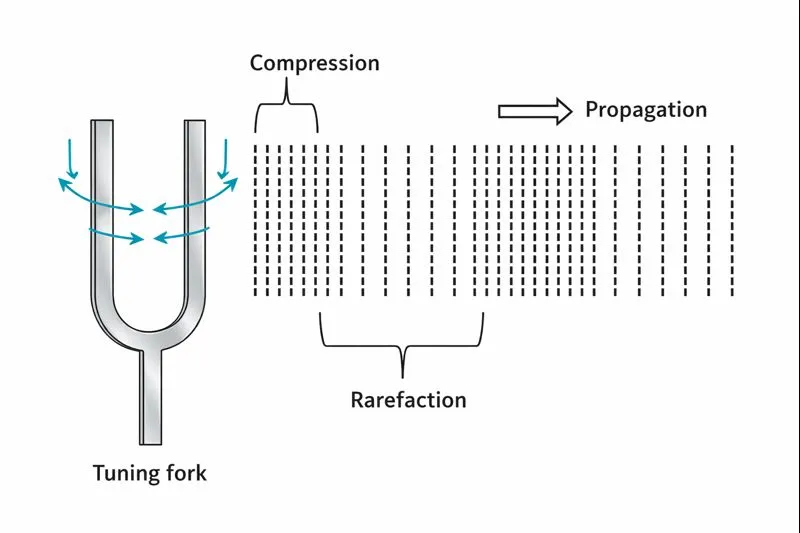
- When the tuning fork moves forward, it pushes nearby air molecules closer together. This region of high pressure is called compression.
- When it moves backward, it leaves extra space. Air molecules spread out, forming a region of low pressure called rarefaction.
- These compressions and rarefactions travel through air as a longitudinal sound wave.
- When the wave reaches the ear, it makes the eardrum vibrate.
- The brain interprets these vibrations as sound.
If the tuning fork stops vibrating, compressions and rarefactions stop forming, and the sound immediately dies out.
For exam-oriented practice based on such explanations, students can solve Class 9 Sound questions and answers.
Why Vibration Alone Is Not Enough
Although vibration is necessary, a medium is also required.
- Without vibration ? no disturbance ? no sound
- Without a medium (vacuum) ? no particles ? no sound
This explains why sound cannot travel through outer space.
Numericals based on these principles are covered in important numericals from the Sound chapter.
Connection Between Vibration and Sound Properties
Loudness depends on the amplitude of vibration.
Larger amplitude vibrations create stronger compressions and rarefactions, producing louder sound.
$$
I \propto A^2
$$
Pitch depends on the frequency of vibration.
Faster vibrations mean more waves per second, producing a higher pitch.
$$
f = \frac{1}{T}
$$
For quick visual revision, students may refer to Class 9 Sound mind maps.
Exam-Ready Conclusion
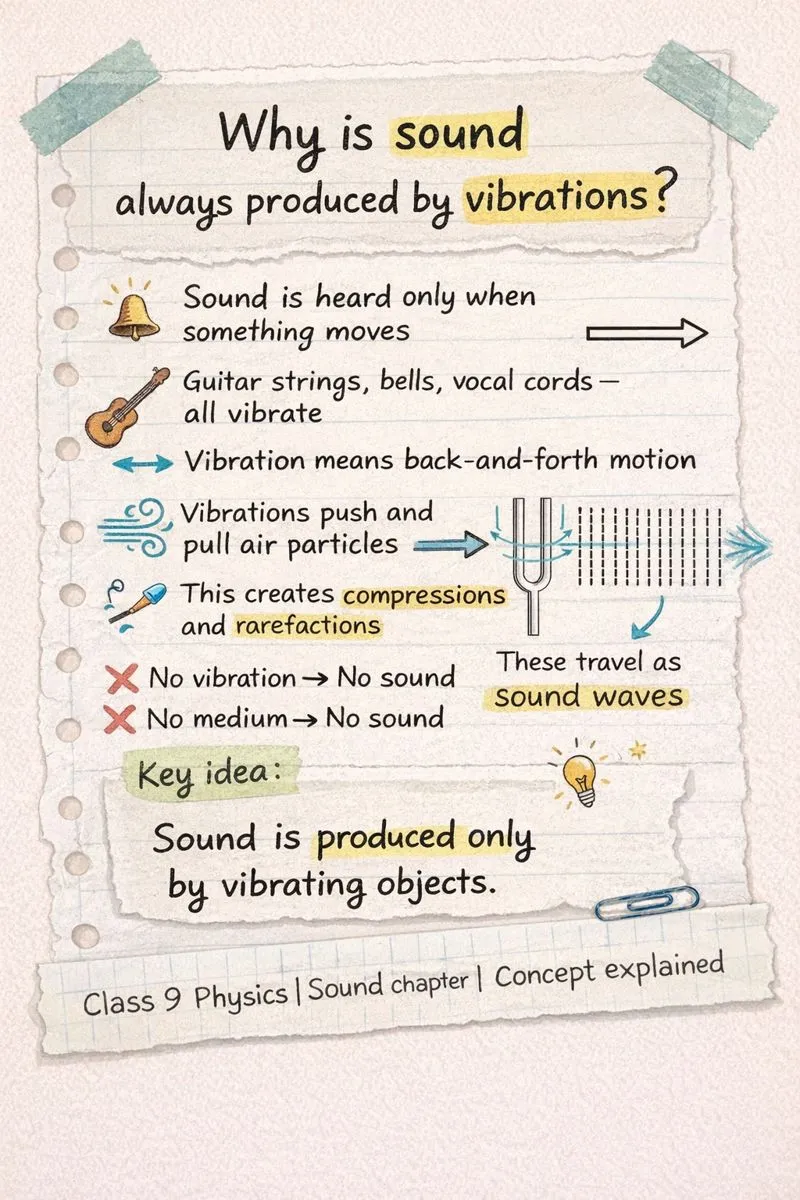
Sound is always produced by vibrations because vibrating objects cause the surrounding air particles to vibrate, producing compressions and rarefactions. These pressure variations travel through the medium as sound waves and reach our ears, where they are perceived as sound.
Without vibration, sound cannot be produced.
For complete preparation of the chapter, visit the Class 9 Science syllabus and resources page.
FAQs: Why Is Sound Always Produced by Vibrations?
Q1. Why is sound produced only by vibrating objects?
Sound is produced only by vibrating objects because vibrations disturb air particles and create sound waves.
Q2. Can a stationary object produce sound?
No. A stationary object cannot disturb the surrounding medium and hence cannot produce sound.
Q3. What type of motion produces sound?
Sound is produced by back-and-forth motion called vibration.
Q4. Why does sound stop when vibrations stop?
When vibrations stop, compressions and rarefactions stop forming, so sound ends immediately.
Q5. Why can sound not travel in vacuum?
Sound cannot travel in vacuum because there are no particles to transmit vibrations.
Q6. How are loudness and pitch related to vibration?
Loudness depends on vibration amplitude, while pitch depends on vibration frequency.