
Let each side of cube be x m.
Answer
Ratio of sides of cuboid is 1:2:4.
Let the sides be y ,2y and 4y m
Now as per question
Volume of cube= volume of cuboid
$x^3=y \times 2y \times 4y=8y^3$
or x=2y
Surface Area of Cube = $6x^2= 24y^2$
Surface Area of Cubiod=$2(lb+lh+bh) =2(2y^2 + 8y^2 + 4y^2)$
As per the question
$[2(2y^2 + 8y^2 + 4y^2) - 24y^2 ] \times 5 =80$
$20y^2 = 80$
y=2
Therefore Side of cube = 4 m
Volume of cube =$(4)^3=64 \ m^3$
Now the sides of cuboid=y,2y,4y=2,4,8m
Therefore Volume of cuboid =$2 \times 4 \times 8=64 \ m^3$
Dimension of Cylinder
Answer
$H_1=3 \ m$
r=14 m
Dimension of Cone
$H_2= 13.5 - 3 = 10.5 \ m$
r= 14 cm
Curved Surface Area of Tent = Curved Surface Area of Cylinder + Curved Surface Area of Cone
$=2 \pi rh_1 + \pi r \sqrt {r^2 + H_2^2}$
=1034 sq m
So cost will be = 1034 * 3 =Rs 3102
d= 7 cm, r= 3.5 cm
Answer
h=12 cm
Volume of Glass = $\pi r^2 h= 462 \ cm^3$
Volume of Glass for 1600 students= 1600 * 462=739200 cm3 = 739.2 litre
$\frac {4}{3} \pi R^3= 8 \frac {4}{3} \pi (2)^3$
Answer
R=4mm
Initial radius=r
Answer
Original surface area =$4 \pi r^2$
If the radius of the sphere is decreased by 30% then its radius becomes 7r/10
Then the surface area of the new sphere will be
$= 4 \pi (\frac {7r}{10})^2 =\frac {49}{100} \times 4 \pi r^2$
Now the surface area is decreased by
$=\frac {4 \pi r^2 - 4 \pi r^2 \times \frac {49}{100}}{4 \pi r^2}= \frac {51}{100}$
So the percentage of the change in surface area is 51%.
$R= 2r$ and $H=\frac {h}{2}$
Answer
$S= 2 \pi RH= 2 \pi (2r) \frac {h}{2}= 2 \pi rh$
So CSA remains same
Answer
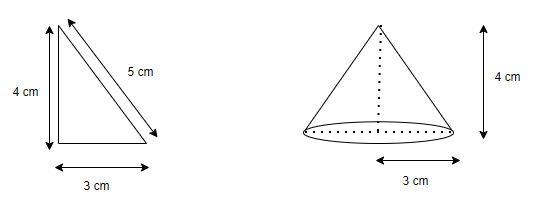
Volume of cone =$\frac {1}{3} \pi r^2 h= \frac {1}{3} \times \frac {22}{7} \times 9 \times 4=\frac {264}{7} cm^3 $
total surface area= $\pi rl + \pi r^2=15 \pi + 9 \pi =24 \pi cm^2 $
$s= \pi rl$
Answer
$v= \frac {1}{3} \pi r^2 h$
Taking LHS
$3v h^3 + 9v^2 -s^2 h^2$
=$3 (\frac {1}{3} \pi r^2 h) h^3 + 9 (\frac {1}{3} \pi r^2 h)^2 - (\pi rl)^2 h^2$
$=\pi ^2 r^2 h^4 + \pi ^2 r^4 h^2 - \pi ^2 r^2 h^2 l^2$
Now $l^2 = h^2 + r^2$
$=0$
Hence Proved
Diameter of Cone= r, Radius= r/2
Answer
Height =r
Volume of cone=$ \frac {1}{3} \pi r^2 h$
$= \frac {1}{3} \pi (r/2)^2 r$
$=\frac {1}{12} \pi r^3$
Number of plank that can be stored =$\frac {\text{Volume of pit}}{\text {Volume of each plank}} = \frac {20 \times 6 \times .8}{5 \times .25 \times .1}=768$
Answer
Surface area of sphere= $4 \pi r^2= 400 \pi \ cm^2$
Answer
curved surface area of cone=$ \pi rl \ cm^2 =4 \pi l \ cm^2$
Now As per the question
$400 \pi= 5 \times 4 \pi l$
l=5 cm
Now we know that
$l^2 = h^2 + r^2$
or $h^2 = l^2 - r^2 =5^2 - 4^2 = 3^2$
h= 3 cm
Now Volume of Cone is given by
$V= \frac {1}{3} \pi r^2 h$
Substituting the values
V=50.29 cm3
Number of ladoos = $\frac {\text{Volume of Big Ladoo}}{\text{Volume of smal ladoo}}= \frac {\frac {4}{3} \pi (5)^3}{ \frac {4}{3} \pi (2.5)^3}=8$
Answer
Let the radius of sphere= r= Radius of a right circular cylinder
Answer
As per to the question,
Volume of cylinder= volume of a sphere
$\pi r^2 h=\frac {4}{3} \pi r^3$
$h=\frac {4}{3}r$
Now Diameter of the cylinder = 2r
So, Inreased diameter from height of the cylinder =$2r-\frac {4}{3}r=\frac {2}{3} r$
Therefore percentage increase in diameter of the cylinder =$ \frac {(2/3)r \times 100}{(4/3)r=50$ %
CSA of cone = π rl
Answer
Therefore
$113.04= 3.14 \times r \times 12$
or r=3 cm
Now
$l = \sqrt {r^2 + h^2}$
or
$h = \sqrt {l^2 - r^2} = \sqrt {135} = 3 \sqrt {15}$ cm
Let a be the edge
Answer
Original Surface Area= $6a^2$
If edge of cube is increased by 50%, then edge becomes = 1.5a
New Surface Area = $6 (1.5a)^2= 13.5a^2$
% increase = $\frac { 13.5a^2 - 6a^2}{6a^2} \times 100= 125$%

Let h be the depth of water in the tank
Answer
Height of rain water falling in 1 min = 2mm
Height of rain water falling in 1hr =2*60=120 mm
Height of rain water falling in 5 hr =600 mm=.6m
Therefore Volume of rain water which falls on land =4000 * 0.6=2400 m3
Now Volume of water filled in tank = Volume of rain water which falls on land
So, $50 \times 40 \times \times h=2400$
h = 1.2 m
Volume of a cuboid tank=LBH
Answer
Now after 5 hours, the height of the water is 20cm,
So, Volume of water in the tank in 5 hours =$225 \times 162 \times .20 =7290 m^3$
Let x m/ hour be the speed of the water flowing thought the aperture.
Then, Volume of water flown through the aperture in 5 hours =$.6 \times .45 \times 5x$
Now This should be equal to water volume in tank
$.6 \times .45 \times 5x=7290 $
x=5400 m/hr
Volume of single solid sphere= sum of the volume of small sphere
Answer
$\frac {4}{3} \pi R^3=\frac {4}{3} \pi (1)^3 + \frac {4}{3} \pi (6)^3 + \frac {4}{3} \pi (8)^3$
$R^3=1 + 216+512=729$
$R=9$ cm
Volume of Liquid = Volume of Box - 16 × Volume of one sphere
Volume of Box= LBH
Volume of Sphere = $\frac {4}{3} \pi r^3}$
Substituting the values
Volume of Liquid =488 cm3
Answer
Radius of semi - circular piece= 14 cm
Answer
Circumference of Sheet= &pi R=44 cm
Now when semi- circular sheet is bent to form an open conical container.
Circumference of Base of Cone = Circumference of Sheet
$2 \pi r= 44$
r= 7 cm
Now Slant height of cone= Radius of the plate = 14 cm
Now height of cone can be derived from the formula
$l^2 = h^2 + r^2$
$h= 7 \sqrt 3 $ cm
Now Volume of Cone is given by
$V= \frac {1}{3} \pi r^2 h$
Substituting the values
V=622.3 cm3
Volume of 4 cm cube=64 cm3
Answer
Volume of 1 cm cube=1 cm3
Therefore total 64 cube were formed
Surface area of 1 cm cube=6 (1) 2 =6 cm2
Total Surface area of all 64 cube=384 cm2
Surface of Original cube= 6(4) 2 =96 cm2
Ration= 384/96= 4:1
This is same as question 7
Answer
Volume of cone =$\frac {1}{3} \pi r^2 h= \frac {1}{3} \times \frac {22}{7} \times 25 \times 12=\frac {2200}{7} cm^3 $
$V = \frac {4}{3} \pi r^3 = \frac {4}{3} \frac {22}{7} (4.9)^3=493 cm^3 $
Answer
Now
Density = mass /volume
or
Mass = Density * volume= 7.8 * 493=3845 g$
Volume of 1 Sphere=$\frac {4}{3} \pi r^3$
Answer
Volume of 27 Sphere=$27 \times \frac {4}{3} \pi r^3= 36 \pi r^3$
Now Volume of 27 Sphere= Volume of Large Sphere
$36 \pi r^3= \frac {4}{3} \pi R^3$
$R=3r$
Now $s= 4 \pi r^2$
$S= 4 \pi R^2= 36 \pi r^2$
Therefore
$s : S = 1 :9$
Here
Answer
L+B+H=21
$\sqrt {L^2 + B^2 + H^2} =12$ or $L^2 + B^2 + H^2=144$
Now
$(L+B+H)^2 = L^2 + B^2 + H^2 + 2(LB+BH+ LH)$
or
$2(LB+BH+ LH)= (L+B+H)^2 -(L^2 + B^2 + H^2 )=441- 144=297 cm^2$
Let L,B and H be x,2x,3x
Answer
Now Total Surface= 2(LB+BH+ LH)
Therefore
$2(2x^2 + 3x^2 + 6x^2)=88$
$x=2$ m
So dimensions are 2, 4, 6 m
This Surface area and volume class 9 worksheet with solutions is prepared keeping in mind the latest syllabus of CBSE . This has been designed in a way to improve the academic performance of the students. If you find mistakes , please do provide the feedback on the mail. You can download this test as pdf also as below