
Sound as a Physical Phenomenon
We already know from everyday experience that sound is produced by vibrations. When an object vibrates, it sets the surrounding medium into vibration. However, production of sound alone is not sufficient. For us to hear sound, it must travel from the source to the listener.
This immediately leads us to a question:
What is required for sound to travel from one point to another?
For a all the resources on this concept, refer to Sound chapter hub.
Sound Needs a Medium to Propagate
We know that, sound is a mechanical wave. A mechanical wave always requires a material medium for its propagation.

The medium can be:
- air (gases),
- water (liquids),
- metals, wood, etc. (solids).
Sound cannot propagate on its own. It moves by transferring vibrations from one particle of the medium to the next. This idea is discussed in detail in the main Sound Class 9 Notes.
How Sound Travels in Air
Let us understand the process step by step using air as the medium.
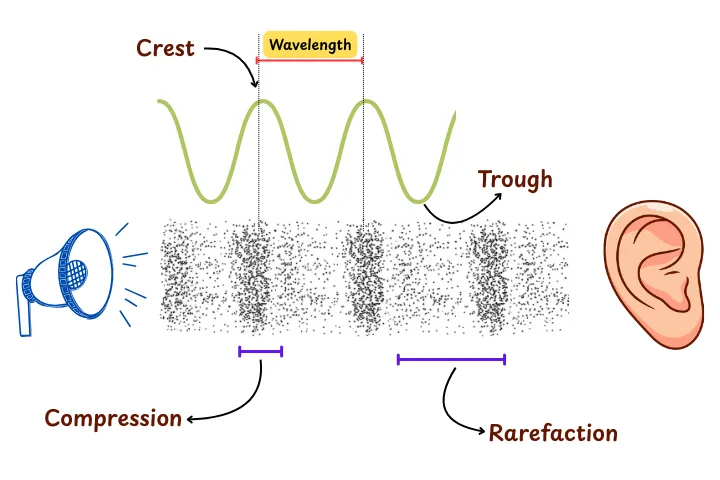
- A vibrating source (for example, a bell) moves to and fro.
- It pushes the nearby air particles, creating a compression.
- These particles then move back, creating a rarefaction.
- The disturbance travels through successive compressions and rarefactions.
- When these vibrations reach our ears, the brain interprets them as sound.
This process requires:
- particles of a medium,
- transfer of vibration energy.
The relation between vibrations and sound production is explained further in the cluster article Why Is Sound Produced by Vibrations?.
What Happens in a Vacuum
A vacuum means the absence of particles.
So step by step:
- Vacuum has no air.
- No air means no particles.
- No particles means no vibrations can be transferred.
- Therefore, sound cannot propagate.
This is why, in the bell jar experiment described in Class 9 NCERT:
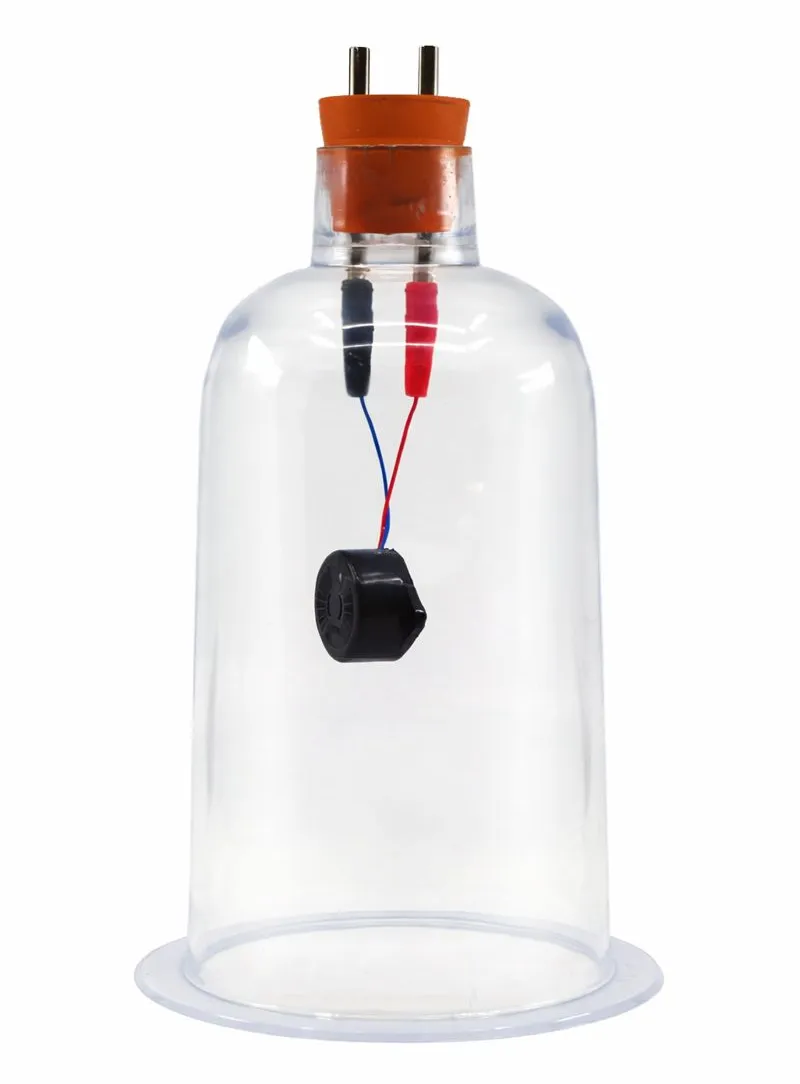
- the bell continues to vibrate,
- but the sound becomes weaker as air is removed,
- and finally becomes inaudible when a vacuum is created.
The source is vibrating, but there is no carrier to transport sound. You can practise similar NCERT-based explanations using NCERT Solutions Class 9 Science – Sound.
Important Comparisons for Conceptual Clarity
Sound in solids and liquids
Sound can travel in solids and liquids because particles are present and closely packed.
Sound vs light
Sound is a mechanical wave and needs a medium.
Light is an electromagnetic wave and can travel in vacuum.
Communication in space
Astronauts use radio waves, not sound waves, because radio waves do not require a medium.
For revision and exam practice, you may also attempt:
- Sound Class 9 Questions and Answers
- Sound Class 9 Extra Questions
- Sound MCQ Test – Chapter Wise
- Numerical applications based on this idea are available in Sound Class 9 Numericals.
Final Explanation
Sound cannot travel in vacuum because sound waves require a material medium for propagation. Sound travels by vibrating the particles of the medium. Since vacuum has no particles, there is nothing to carry sound waves, and hence sound cannot travel through vacuum.
For a visual overview of the entire chapter, see Sound Mind Maps.
You can explore all Class 9 Science chapters from the Class 9 Science hub.
Frequently Asked Questions on Sound Travel in Vacuum
1: Can sound travel in vacuum if the source is vibrating?
No. Even if the source continues to vibrate, sound cannot travel in vacuum because there are no particles to transmit the vibrations from one place to another.
2: Why does sound need a material medium to propagate?
Sound is a mechanical wave. It propagates by transferring energy through vibrations of particles in a medium such as air, water, or solids. Without a medium, this transfer is not possible.
3: How is sound transmission in air explained using compressions and rarefactions?
In air, sound travels as a series of compressions (regions of high pressure) and rarefactions (regions of low pressure) formed due to the back-and-forth motion of air particles caused by a vibrating source.