Question 1 – Name two animals which can produce infrasonic waves.
Answer: Elephant and whale.

This page contains extra questions on Sound for Class 9 Science, prepared strictly according to the CBSE and NCERT syllabus. These questions are useful for revision, school exams, and strengthening conceptual understanding of the Sound chapter.
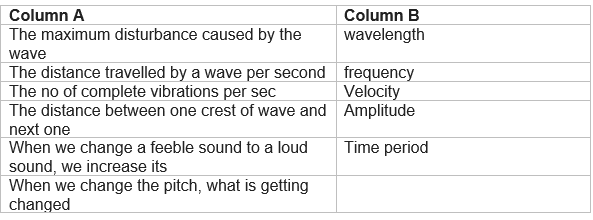
Answer:
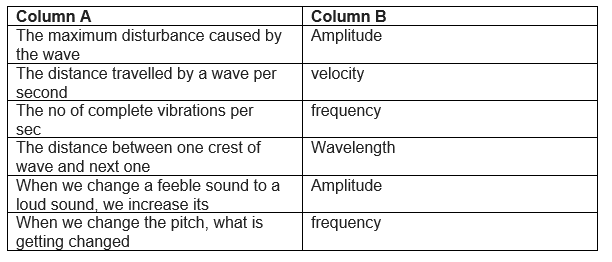
This section includes one-mark extra questions from the chapter Sound, focusing on definitions, basic concepts, and fundamental properties of sound waves.
Answer: Elephant and whale.
Answer: Reverberation is the persistence of sound in a closed space due to multiple reflections from walls, ceiling, and other surfaces even after the source has stopped producing sound.
Answer: Echo is the repetition of a sound heard after reflection from a distant surface when the reflected sound reaches the ear after at least 0.1 s.
Answer: Infrasonic sound is sound having frequency less than 20 Hz.
Example: Sound produced by elephants.
Answer: Elephants and whales can hear infrasonic sound.
Answer:
Answer: The audible range of the human ear is from 20 Hz to 20,000 Hz.
Answer: Sound travels faster than the truck, so the sound waves reach our ears before the truck itself arrives.
Answer: We know, f = 1/T
f = 1/0.025 = 40 Hz
So, the frequency of the wave is 40 Hz.
Answer: The characteristic of sound involved is quality (timbre).
Answer:
(a) Echolocation: Echolocation is the technique used by animals such as bats and dolphins to locate objects by emitting ultrasonic sound waves and detecting the echoes reflected from those objects.
(b) Echocardiography: Echocardiography is a medical technique in which ultrasonic waves are used to obtain images of the heart and study its structure and functioning.
(c) Ultrasonography: Ultrasonography is a diagnostic technique that uses ultrasonic waves to produce images of internal organs of the human body.
Answer:
Fastest: Light travels fastest in air.
Next: Sound travels slower than light but faster than a supersonic aircraft.
Slowest: A supersonic aircraft travels slowest among the three.
Reason: Light travels at a very high speed (about 3 × 10⁸ m/s), sound travels much slower (about 340 m/s in air), and even a supersonic aircraft moves much slower than the speed of sound.
Answer: The minimum time gap required is 0.1 second.
Answer: SONAR stands for Sound Navigation and Ranging.
These extra questions on Sound require brief explanations and help students understand important concepts such as wave motion, reflection of sound, and applications of ultrasound.
Answer: Multiple echoes are produced when a sound is reflected repeatedly between two or more distant reflecting surfaces. Each reflection takes some time to reach the listener. If the time gap between successive reflections is greater than 0.1 s, each reflected sound is heard separately as multiple echoes.
Answer: The velocity of sound in air increases with increase in temperature. As temperature rises, air molecules move faster, allowing sound waves to travel more quickly. Thus, sound travels faster in warm air than in cold air.
Answer: On a summer day, the velocity of sound is higher due to higher temperature. Because of this, the reflected sound returns in less time. The time gap may become less than 0.1 s, so the echo may not be heard distinctly. Hence, the echo heard in winter may not be heard clearly in summer.
Answer: The walls and roof of an auditorium are covered with sound-absorbent materials to reduce excessive reflection of sound. This helps to control reverberation and makes speech and music clearer to the audience.
Answer: Reverberation is the persistence of sound in an enclosed space due to repeated reflections after the sound source has stopped.
To control excessive reverberation:
Answer:
Answer: We know, f = 1/T
f = 1/0.05 = 20 Hz
So, the frequency of the wave is 20 Hz.
Answer:
Answer: SONAR stands for Sound Navigation and Ranging. It uses ultrasonic sound waves to detect and locate underwater objects.
SONAR is used to measure sea depth, locate submarines, and detect underwater obstacles.
Answer:
| Echo | Reverberation |
|---|---|
| Echo is the repetition of sound heard after reflection from a distant surface. | Reverberation is the persistence of sound due to multiple reflections in an enclosed space. |
| It is heard distinctly after a time gap of at least 0.1 s. | The reflected sounds mix with the original sound. |
| Example: Shouting near a cliff. | Example: Sound persisting in a hall. |

Answer: In transverse waves, the particles of the medium vibrate perpendicular to the direction of wave propagation. These waves consist of alternate crests and troughs. Transverse waves can be polarised. They generally propagate in solids and on the surface of liquids.
Answer:
| Infrasonic Sound | Ultrasonic Sound |
|---|---|
| Frequency is less than 20 Hz. | Frequency is greater than 20,000 Hz. |
| It is not audible to human beings. | It is also not audible to human beings. |
| Produced by earthquakes, elephants, etc. | Used in SONAR, medical imaging, and cleaning devices. |
This section contains long answer type extra questions on Sound for Class 9, which are commonly asked in examinations. These questions involve detailed explanations, principles, and working of devices.
Answer:
(A) Reflection of sound refers to the phenomenon in which sound waves bounce back into the same medium after striking a hard surface such as a wall, cliff, or building. Just like light, sound follows the laws of reflection. This reflected sound can be heard as an echo if the reflecting surface is sufficiently far away.
(B) To study the reflection of sound, take a long cardboard or PVC pipe and place a ticking clock or mobile phone at one end. Stand near a large wall and direct the pipe towards it. When you listen through the pipe, the reflected sound can be clearly heard. This shows that sound waves travel, strike the wall, and return to the listener due to reflection.
Answer: Bats detect their prey by a process called echolocation. They produce ultrasonic sound waves which travel through air and strike insects or other objects. These sound waves are reflected back as echoes. By analysing the time delay and nature of the reflected sound, bats determine the distance, size, and position of their prey.
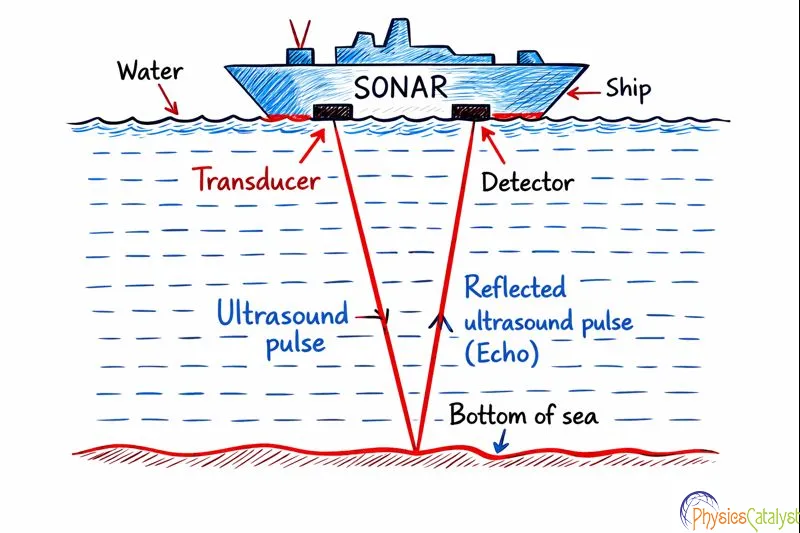
Answer: SONAR stands for Sound Navigation and Ranging. It works on the principle of reflection of sound waves.
In SONAR, a transmitter fitted on a ship produces ultrasonic sound waves. These waves travel through water and strike an underwater object such as a submarine or the sea bed. The reflected waves (echoes) are received by a detector. The time taken for the sound to travel to the object and return is noted.
If t is the time taken and v is the velocity of sound in water, then the distance d of the object is given by:
d = (v × t) / 2
Answer: An echo is the repetition of a sound heard after it is reflected from a distant surface such as a wall, cliff, or mountain. When a sound is produced, it travels through a medium and strikes a reflecting surface. The sound waves are reflected back and reach the listener's ear after some time delay, producing an echo.
For an echo to be heard distinctly, the following conditions must be satisfied:
Thus, echoes are commonly heard in large open spaces like valleys, hills, and empty halls.
Answer:
| Transverse Waves | Longitudinal Waves |
|---|---|
| Particles vibrate perpendicular to the direction of wave motion | Particles vibrate parallel to the direction of wave motion |
| Show crests and troughs | Show compressions and rarefactions |
| Example: Waves on water surface | Example: Sound waves in air |
Answer: Wave motion is the propagation of a disturbance through a medium in which energy is transferred from one point to another without any net transfer of matter.
In wave motion, energy travels through the medium while the particles only oscillate about their mean positions. There is no permanent displacement of particles.
Each particle of the medium starts vibrating when the wave reaches it. The vibration is periodic and occurs with the same frequency as the source.
A wave travels with a definite speed that depends on the nature of the medium, not on particle speed.
Successive particles receive vibrations with a small time delay, producing the wave pattern.
Answer:
Sound waves are called mechanical waves because they require a material medium for their propagation. Sound cannot travel in vacuum, which shows that particles of a medium are necessary to transmit the disturbance. The vibration of particles in solids, liquids, or gases helps in the transfer of sound energy from one point to another.
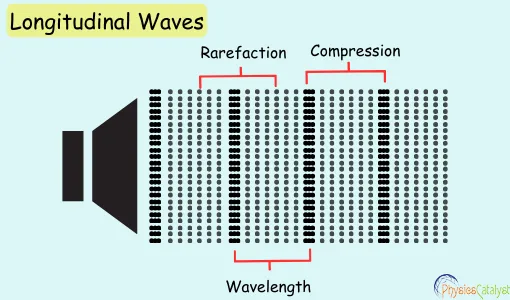
When a vibrating source moves forward, it compresses the air particles, forming a region of high pressure called compression. When it moves backward, a region of low pressure called rarefaction is formed. These compressions and rarefactions travel through the medium as a longitudinal wave, carrying sound energy forward.
Answer: Ultrasound has several important applications in the field of medicine due to its ability to penetrate soft tissues without causing damage.
Ultrasound is widely used to obtain images of internal organs such as the liver, kidneys, heart, and foetus. It helps doctors diagnose diseases without surgery.
High-frequency ultrasonic waves are used to break kidney stones into very small fragments, which can then pass out naturally through urine.
Ultrasound is used to study the structure and functioning of the heart, helping in the detection of heart-related problems.
Thus, ultrasound plays a safe and vital role in medical diagnosis and treatment.
These questions require labelled diagrams to explain the propagation and characteristics of sound waves. Practising such questions helps in scoring full marks in board-pattern exams.
This section includes application-based and HOTS extra questions from the chapter Sound, which test conceptual clarity and real-life applications of sound.
Students should practise these Class 9 Sound extra questions after completing the NCERT textbook exercises. These questions cover important concepts and help in writing well-structured answers in school examinations.
Students who want to revise the theory of this chapter can refer to the Sound Class 9 Notes, which explain all concepts such as production of sound, longitudinal waves, echo, and characteristics of sound in a simple manner. For textbook-based preparation, the NCERT Solutions for Class 9 Science Sound provide clear and step-by-step answers to all NCERT questions.
To strengthen problem-solving skills, students should practise the numerical questions on Sound for Class 9, which cover applications of formulas related to speed, frequency, wavelength, and echo. Additional practice can be done using online multiple-choice questions available in the Sound Class 9 MCQ tests.
All study resources related to this chapter, including notes, worksheets, numericals, MCQs, and extra questions, are organised on the main chapter page Sound – Class 9. Students can also explore other chapters from the Class 9 Science syllabus for complete exam preparation.