The machinery devices that we used in our daily life run on electricity. For example, we watch our favorite shows on TV, wash and dry our clothes on the washing machine and enjoy playing video games on mobile or PC.
The devices that run on electricity are called electric appliances.
We can define “electricity” as the form of energy that converts into other types of energy. For example, a doorbell converts electrical energy into sound energy, and the geyser converts electrical energy into heat energy.
Electricity
When you observe the torch, you will notice a small bulb in front of it and a switch located at the side of the torch that has two markings on it: ON and OFF: If you press the “ON” side of the switch, the bulb glows then press the “OFF” side of the switch, the bulb stops illuminating. When the switch is on, the “electric current” starts flowing inside the torch that provides energy to the bulb for glowing.
Ammeter: An instrument that measures the amount of electricity flowing in a circuit.
Sources of Electricity
The main sources of electricity are based on the production or conversion of the energy:-
Large-scale production
1. Power stations:
Power stations are responsible for generating a big amount of electricity for industries, factories, houses and school etc.
They are located near the rivers, waterfalls or highly windy areas.
2. Windmills:
A group of aerogenerators placed in windy areas that convert wind energy into electrical energy.
They also produce electrical energy on a large scale.
3. Solar Panels or Plates:
An arrangement of photovoltaic cells on a framework of plates that converts solar energy into electrical energy.
There are varieties of solar panels that exist based on the requirement of the energy in a particular place.
4. Standby generators:
When the electricity cuts, the standby generators provide electricity to the place.
They work on fuels like petrol and diesel.
5. Inverters:
They are used when the electricity cuts.
They work on batteries that are charged by electricity.
Portable sources of electricity
Electric cell
An Italian scientist named “Alessandro Volta” invented the electric cell.
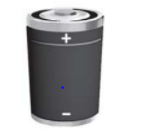
A device that is considered a source of electricity(Figure 1).
A cell has two terminals: positive and negative.
The positive end of the cell has a metal cap on it, while the negative end has a metal disc attached to it.
Figure 1: An Electric Cell
Battery
The cells combined to form a battery. They are arranged by opposite terminals. For example, the negative terminal of a cell is connected with the positive terminal of another cell.
There are some chemicals inside a cell that react with each other to create an electric current.
When the chemicals are saturated, the cell stops producing electric current.
In an electric cell, the body is designed in a cylindrical shape, and its outer cover is covered with plastic or rubber. So, we prevent ourselves from the electric shock.
Types of electric cell
There are two types of electric cells:- Primary electric cell:
The chemicals inside the cell convert the chemical energy into electrical energy. This process is completely irreversible.
They generate only a small amount of electric current.
They are used in the devices such as remote controls, wall clocks, toys flashlights and radios.
Secondary electric cell:
It is a reversible process which means the cell can be recharged and used repeatedly.
They are also called storage cells or accumulators.
These types of cells are used in mobile devices, camcorders, laptops, power tools and motor drives.
In vehicles, they are used for the highlights and air-conditioning system.
Electrical Devices
Electric Bulb
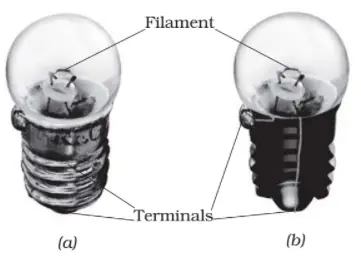
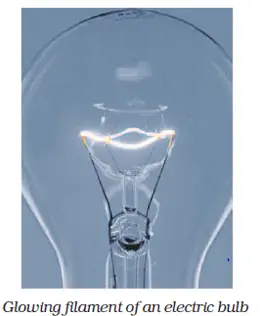
It is the first electrical device(Figure 2) used by a common man.
An electric bulb consists of a transparent glass covering and enclosed with a thin-coiled metal wire called the filament.
The filament is made up of tungsten and has two thick wires that are connected to the metal base of the bulb. These are called the terminals of the bulb.
A bulb converts electrical energy into heat and light energy.
The filament becomes hot when the bulb glows.
If the filament is broken then the bulb does not glow.
Figure 2: An Electric Bulb
Switch:
It is a link between the supply of electric current and a device.
It manages the flow of the electric current in a circuit. When the switch is on, the circuit has electric flow. The circuit is called closed circuit. If the switch is off then the circuit has no current source. This type of circuit called open circuit.
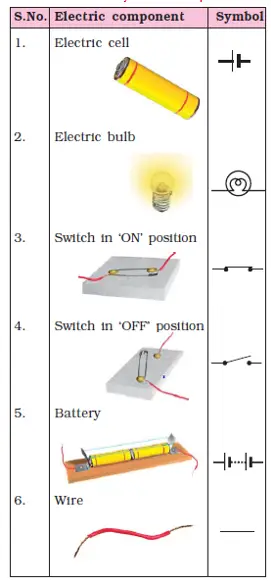
The symbol of an electrical switch is represented as:
Electric current:
The flow of charges through a circuit is called electric current. The SI unit of electric current is ampere and donated by A. The direction of the electric current is conventionally from the positive terminal to the negative terminal of a cell.
Electric circuit:
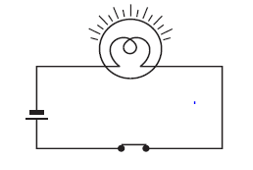
An electric circuit is a complete path for the flow of electric current. A circuit consists of an electric cell devices which use the electrical energy, a switch and connecting wires. These all are called components of the circuit or circuit elements.
If any part of a circuit is broken, electric current does not flow through it and such a circuit is called an open circuit.
If there are no breaks in a circuit, it provides a closed for the flow of electric current and such a circuit is called a closed circuit.
Electric current can flow only through closed circuit
Components of an electric circuit:
Cell or battery:
A cell is a source of current.
It has a positive and a negative terminal.
When two or more cells are connected such that the positive terminal of one cell touches the negative terminal of the other, it forms a battery, but they have to be connected in a proper manner for electricity to flow through the circuit. They can be connected in series or in parallel.
Switch:
A switch is used to close or open a circuit.
When the switch is off, the circuit is open and no current flows through it.
When the switch is on the circuit is closed allowing current to flow.
Electrical appliance:
An electrical appliance is a device that uses the current flowing through it to function.
Electric bulbs, electric iron, fans, electric motors are some commonly used electrical appliances in our daily life.
Wires:
Wires connect the element of the electric circuit. They are made up of materials that are good conductors of electricity such as copper.
Connecting cells in series:
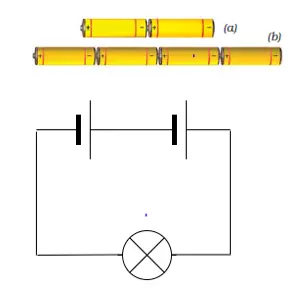
When the cells are connected in series, the positive (+) terminal of one cell is connected to the negative (-) terminal of the other cell. When you complete connecting cells, you will have a positive terminal at one end and the negative terminal at the other end.
Connecting cells in parallel:
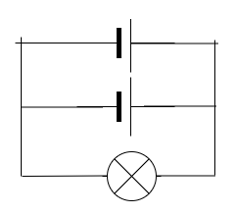
When cells are connected in parallel, the light terminals of cells are linked together. This means that the positive terminal or negative terminal of all the cells are connected together.
Circuit diagram:
A schematic diagram that represents an electric circuit using the standard symbols of the components used in the circuit is called a circuit diagram.
Table of standard symbols component of circuit
Light emitting diode (LED)
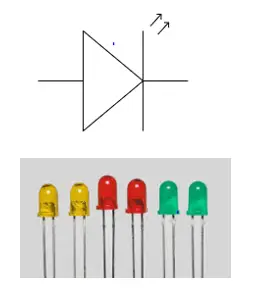
Nowadays, Light emitting diodes (LEDs) are used instead of an electric bulb because they consume less electricity, do not produce heat, have very long life and are almost unbreakable.
An LED allows electric current to follow in one direction only.
LED cannot tolerate even a small change in electric current. A circuit with an LED therefore requires an appropriate resistor. The resistor regulates the flow of electric current and protects the LED.
Heating effect of electric current:
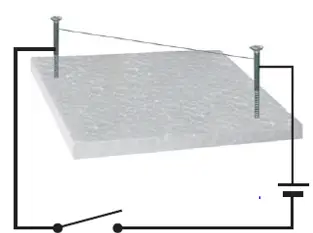
When electric current is passed through a conductor, it produces heat in the conductor and this effect is called the heating effect of electric current.
Electric iron, immersion heaters, hot plates, geysers, electric kettles are some of the electric appliances used, which work on the heating effect of the electric current.
All the devices have a coil of wire called an element. The heating element is made up of metal alloy called nichrome (alloy of 80% nickel and 20% chromium). Nichrome wire have high resistance to electric current and can withstand high temperatures. Due to this property, it is a good material for making heating elements.
When the appliance is switched on, the element becomes red hot and give out heat.
The amount of heat generated by a metal conductor (wire) depends on the strength of electricity flowing through it, the type of metal and on the length and thickness of the conductor.
What makes a bulb glow:
A bulb glows due to the heating effect of electric current.
A bulb has a partial vacuum, argon gas and a thin filament of tungsten.
Tungsten metal has a very high resistance and very high melting point.
When an electric current pass through the filament, due to its high resistance, its heat up quickly to about 2500 degree Celsius.
At this temperature, the tungsten filament begins to glow and emits light.
Electric fuse:
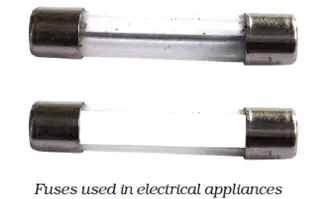
A fuse or an electric fuse is a safety device made of a material with low melting point. it is used to protect the electric circuit and devices in the circuit from the excess current passing through them.
How does a fuse work:
Electric fuse works on the principle of the heating effect of electric current.
The quantity of heat produced in a conductor by a current depends on the amount of current flowing through the conductor.
A fuse is a thin wire of short length that melts easily when heated.
When the fuse wire breaks due to heating by excess amount of current, the circuit breaks and becomes an open circuit; no current can flow through it and the devices in the circuit are safe.
The fuse wire is made from an alloy of tin and lead and has a low melting point. Hence, it melts easily when more than the designated amount of current flows through the circuit.
The main characteristic of a fuse wire are that it must have low melting point and relatively high resistance.