Heat energy always flows from a region of higher temperature to a region of lower temperature, till both attain the same temperature. This phenomenon is called transfer of heat. The main ways by which transfer of heat occurs are Conduction, Convection and radiation.
Conduction:
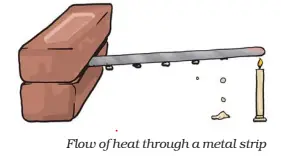
Conduction is the transfer of heat from a hotter part to a colder part of an object due to collision of its particle without actual movement of the particles from their position. Heat transfer through conduction occurs within solids and between solid substances that are in direct contact with each other. How does conduction of heat occur?
In a solid, the molecules are closed arranged. When a solid is heated, the molecules near the source of heat gain thermal energy and begin to vibrate faster.
These molecules then collide with the colder slower molecules and transfer some thermal energy, making them vibrate faster, become warm and then in turn collide and transfer the heat to their neighboring particles and so on
In this way, heat is transferred from one particle to the next through collision of vibrating particles within substances.
Good and Poor conductors of heat:
The rate of conduction of heat is different in different solids.
Materials that conduct heat easily are called conductors. Metals are usually good conductors of heat.
Materials that do not allow the conduction of heat are called insulators. For example, wood, cotton rubber, clay and cock.
Air and water are also insulators of heat.
Materials such as wool, feather and fur act as insulators because air is trapped inside their fibres.
Practical application of conduction:
Pans used for cooking are usually made of metals such as steel, copper or aluminium (good conductors), while their handles are made of plastic (insulator).
Clothes made of fur trap air inside them and this trapped air then acts as an insulator. It prevents heat from escaping, keeping our body warm.
Convection
Convection is the transfer of heat by the movement of particles. Convection is the primary mode of heat transfer in fluids (liquid and gases).
How does convection take place? Convection currents:
When a liquid or gas is heated it expands. As a result, it becomes lighter and moves upwards.
The cooler, heavier fluid from the surroundings rushes to take its place and is heated in turn.
This process continues and gives rise to a convection current through which heat energy flows and the entire liquid or gas gets heated.
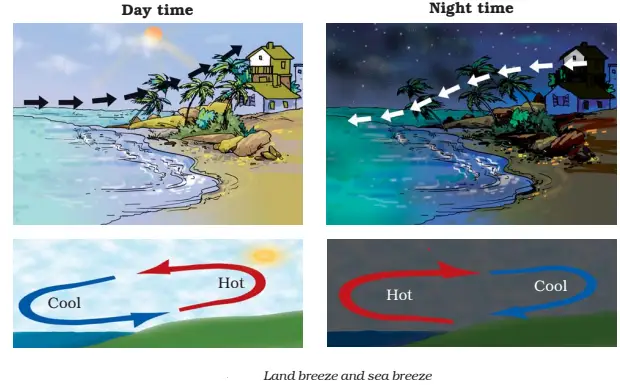
Convection currents give rise to Breeze in coastal regions.
During the day, the land heats up faster than the sea. So the air above the land becomes warmer and rises upwards. The cooler air from above the sea rushes towards the land and takes its place, resulting in a sea breeze during the day.
At night, the land cools faster. Therefore, the air above the sea is warmer than the air over the land. At night, cooler air from the land replaces the warmer air above the sea resulting in a land breeze.
Practical application of conduction:
Exhaust fans in kitchens are always fitted high, close to the ceiling so that they can remove the hot air that rises up.
Room heaters are placed on the floor of a room. When the cool air is heated, it rises up and the cold air flows down to the floor. This results in effective heating of the entire room.
The ventilators of a room at the top of a window or the door. This is because when the air in the room gets heated, it rises and passes out from the ventilators at the top.
Radiation:
The transfer of heat in the form of rays, for which a medium is not required is called radiation.
These waves can move through vacuum.
Working of a thermos flask:
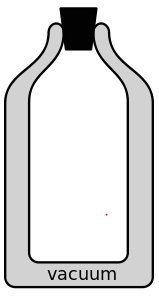
A thermos flask is used to maintain the temperature of liquids kept in it. It keeps hot liquids hot or cold liquids cold for a longer time.
The outer casing of a thermos flask is made up of plastic, which acts as an insulator preventing the heat loss through conduction
Inside it, is a double walled container made of glass or stainless steel.
Both the walls are polished, so they are shiny.
The space between the two walls is a vacuum; this prevents heat loss through convection.
The shiny surface of the wall also prevents heat loss through radiation.
Practical application of radiation:
Solar heaters are designed to use the heat energy from the sun for cooking food.
We prefer wearing light colored clothes in summer because light colors are poor absorbers of heat. Conversely, we prefer wearing dark- colored clothes in winter because they are good absorbers of heat and thus, keep us warm.
Water cycle:
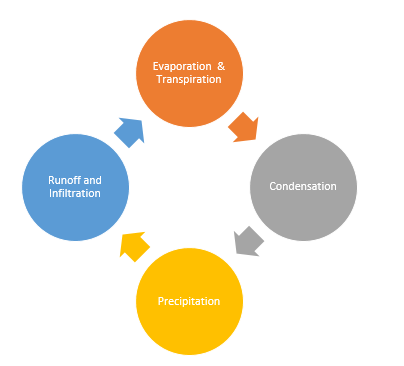
The continuous circulation of water from the Earth's surface to the atmosphere by evaporation and back to the earth by condensation is known as the water cycle.
Water from water bodies and moist soil evaporates and rises up in the air in the form of water vapour (gaseous state). Plants also give out water from their leaves in high amount as a result of transpiration.
When this vapour rises up, it condenses to form clouds, in which the vapour cools down to form water droplets.
When the clouds get too saturated with water, they pour down as rain (liquid state), by the process called precipitation.
In colder regions, water drops freeze and fall as hail or snow (solid state).
The rainwater that falls into seas, rivers, lakes etc. increases their water level. The water from these water bodies evaporates back into the atmosphere, completing the water cycle.